Sunday, 13 September 2009

Pectoral Sandpiper

Having walked all around Worcestershire on Saturday and photographed almost nothing, the news that a pectoral sandpiper had been spotted at Draycote Water was a relief.

I didn't get there particularly early and as I walked up towards the lake, I spotted Dave Hutton loading his kit back into his car. He'd been there early, and judging by his pics, he'd enjoyed some cracking views of the bird.

Dave had to head home to grab some hours kip before work, but he mentioned that Steve Seal was around too. He was, munching on some rolls when I caught up with him. Always a pleasure to chat to Steve - so enthusiastic and entertaining. Another one of the early risers, he'd also managed to get some cracking shots... annoying as the fishermen had scared the bird away by the time I had almost got close to it.

All was not lost though, as whilst I trudged back to the car park, I spotted one of the dunlins that had been with the pectoral sandpiper, and yes, it was still with it. Didn't take long for other photographers to clock on to me and join in, photographing it, as it pottered around on the shoreline.


I managed a few shots with other birds in shot, such as the ringed plover, dunlin and a young mallard.

As the chill from Draycote cut through my fleece, I opted to head off, accompanied by Di Stone, who had also felt the cold! There was one surprise left though, as on the walk back, I spotted a weasel, peeking out from between the rocks on the bank of the lake. Cheeky, inquisitive little character! Rather cute too, and a brilliant subject to photograph. It'll be appearing on my Wildlife Gallery very soon.


After seeing a pectoral sandpiper in Cley this week, albeit at somewhat of a distance, it was lovely to get the chance to photo one closer up - a fine addition to the gallery, and a good day catching up with friends.

Norfolk Again

Normally, this time of year is spent down in Somerset, but due to family circumstances, the planned trip had to be cancelled, so I was at a loose end for a week. Rather than waste it (tidying the house or garden, perhaps!), I opted for a few days in Norfolk, to take my time wandering around places I'm usually rushed for time at.

Wells-next-the-Sea

While the forecast for the week was pretty good, Monday was rather cloudy, so I took the chance to wander around Wells-next-the-Sea. The marshes are a good spot for waders, and I spotted plenty of oystercatchers, curlew and redshanks pottering about. A kestrel led me on a merry dance, never allowing me close enough for a decent shot, and I was chuffed to see a rather splendid marsh harrier float by.

The other end of Wells is more "touristy", but walking along the quay provided decent views of turnstones, curlew and redshank again, plus ringed plovers and dunlin near the edge of the water.

Cley

I tried to visit Cley as often as possible, as it's probably my favourite reserve. Strangely, the birds around varied dramatically from day to day. It was great to see the spoonbills again, this time from a closer viewpoint, and when something sparked all the birds into the air, I managed some flight shots too.


Marsh harriers were abundant on the Tuesday, but apparently missing for the rest of the time. I caught them drifting back in one evening, when I stayed around to watch the sunset over the marshes.


Aside from the harriers at sunset, small flocks of starlings provided entertainment, though no real fancy shapes against the setting sun.


Pinging all around, the bearded tits teased from within the reeds, only really appearing on the one evening, in difficult light. Still, they're beautiful birds to watch - though I've not managed a shot of an adult male yet...


At the back of Cley, wheatears, linnets and meadow pipits flitted across the shingle, and the fledgling swallows took advantage of wire fences and old branches to perch, waiting for their frenetic parents to bring them their tea.
Around the various lakes were all manner of waders, with a few new ones for me being seen; spotted redshanks, a pectoral sandpiper, curlew sandpipers and a ruddy shelduck, that I thought was a goose!

Salthouse

Winter months here are great for getting shots of turnstone and snow buntings, but neither were present at this time of year. However, perched / sat resting on the edge of the footpath was a juvenile gannet. It took a bit of crawling around on all fours to get close, but was well worth it when the bird took the occasional look around. Quite ugly looking birds as juveniles!
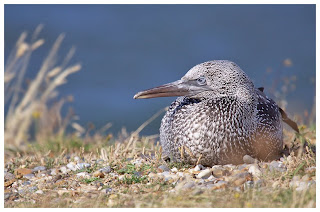


This was also a good place to soak up some afternoon sunshine with a pint of Wherry, purchased very kindly by Max who was also up in Norfolk for a couple of the days when I was there. Cheers!

Titchwell

I hoped that 3rd time would prove to be lucky here in terms of success, but again it let me down. With work continuing on the sea defences, little was about, and I left disappointed once more. And this was coupled with my poor timing for a very high tide, which meant Thornham and Brancaster harbours were equally barren.

Hickling Broad

I persuaded Max to join me for a walk around here, despite him saying that it was a poor spot from his last visit. Should have listened... as very little was about. Got some distant views of a pair of marsh harriers, and heard the pings from numerous bearded tits, but no sightings.

The highlights though, were when a hobby flew within 10 feet of me and then shot off down the road towards Max (I think he got some decent shots), and a flock of common cranes that drifted by, though very much at a distance.

Winterton Dunes

This was Max's idea, and initially seemed to have drawn a blank too. However, wandering back into the more floral area of the dunes, yielded stonechats and a kestrel, and a female redstart, hiding in the bushes. It also provided a café for a bite to eat and a dodgy cup of tea. Max scoffed a rather large slice of cake!

Burnham Overy

I'm not entirely sure what the proper name is for this location. It's known as "The Layby" to most folks, and provides (sometimes) some fabulous views of barn owls. The path along the river also gifted me views of a chiffchaff (I think) and a female redstart. And there was a pair of marsh harriers around, plus couple of deer and a few noisy herons.

But the barn owls were the star of the show. They'd appear from nowhere, ghosting past you suddenly, quartering the fields, hovering and diving into the grass. I was lucky to catch some shots of one of the birds with the golden evening light on it.


If only moments like this could be bottled and reopened to relive over and over.
Four thoroughly enjoyable days spent in Norfolk, and a trip to be repeated I think, if I get some spare time again.

Thursday, 3 September 2009

Gulls and Terns

Aside from bird photography one of my other interests revolves around cars. Mainly sports cars, but I like to read about everyday ones too. The likes of Ferrari, Porsche, Aston Martin and Jaguar provide cars with real style and excitement. I'll probably never be able to afford such a model, but they're still wonderful to admire.

In amongst the vast array of cars though are MPVs. People Carriers. I'll probably offend some now, but buying one of these to me, is saying you've given up on life and opted to accept the notion that having a couple of kids means you have to drive one of these.

It doesn't matter what the manufacturers do to them; Vauxhall have a VXR version with a turbo-charged engine and racy wheels for example, that hits 60 in about 7 seconds. Hot hatch performance. But it's still just an MPV and as such holds no interest for me at all.

Which brings us on to gulls. I like most species of bird, especially birds of prey - perhaps the peregrine falcon is the McLaren F1 of the world (I don't really like the look of the Veyron), but gulls just don't seem to do it for me. Sure I have pictures of them in my gallery and if they're around me when I'm photographing something else, I'll take a shot, but making the effort to go to see one in its own right?

I appreciate that it's rare, but going over to the Flashes at dusk, to get a record shot of the Sabine's gull just hasn't been attractive to me at all. I'm not alone with this though, as a friend of mine isn't interested in LBJs at all, concentrating almost all of his bird photography on birds of prey. So apologies for anyone looking for pics of the Sabine's gull on my gallery... there aren't any! Yet.

Bizarrely, given this attitude it's strange that I do like terns. And as such, I've been over to the Moors lately to get shots of the juvenile black tern. What a tricky subject to photograph! They fly pretty quickly normally, but in the blink of an eye, dive and swoop over the surface of the water, rising back up, only to dive again. Makes following them with the camera a real challenge.


Maybe if it relocates to the Flashes, then I could wait around for dusk, and get pics of anything else around at that time?

Tuesday, 25 August 2009

Otmoor and the Chilterns

The weekend's birding started straight after work on Friday with a visit to Brandon Marsh. I had hoped to see some greenshanks, after admiring several friends' photos of these waders, especially as it is a bird I've not had any decent close views of, to date.

And... that's still the case! The only one around was on the far side of the River Pool, though it later relocated to the far side of the Teal Pool, where the light is terrible from lunchtime onwards.

Having spent much of the previous weekend camped in the Hen Pool Hide at Upton Warren, I was not that keen to go again, afterall, there's only so many pictures of a reed warbler you can process, without starting to go a little mad! So I browsed the net and opted to head south down the M40, to Oxfordshire first, to the RSPB Otmoor reserve.

If you're planning to go here, a word of warning. There's only one road to it and it really is dreadful. I managed to bottom out the car and clunk worryingly down into a huge pothole. Good job I was only crawling along.

The reserve though is well worth the trip. Reminded me of Exminster Marshes (Devon) to be honest, and the birds within were similar too. I heard Cetti's, reed and sedge warblers, watched several herons squark their way noisily between pools, and towards the centre of the conservation area, at least 4 hobbies hawked along the reedbeds, skillfully catching dragonflies with mid-air acrobatics.

The walk around the reserve ought to be circular - always bug me when they're not (like this one), as you have to trudge back the way you came... However, for the insect-lovers out there, this ought to be heaven. Masses of different butterflies and moths, and dragonflies - I've never seen so many!!

At the end of the walk is a pool with a viewing screen, and that held 2 black-tailed godwits, several lapwings, a flock of Canada geese, a lone common sandpiper and a common snipe. The other pools had the usual moorhens and coots, plus a few shovelers too.

Behind the reserve, 3 or 4 red kites circled the fields, and in the field / building site nearby, a kestrel hovered. In fact there were 3 around, in different parts of the reserve.

Arriving back at the start of the walk, I was just in time to see the marsh harrier, a juvenile, making a brief appearance. Bit of a distance, but great to watch nonetheless. One that had flown off, it was left to the hobbies to entertain, though with the conservation area being so large, they rarely came close.


I was actually about to head back to the car when something else caught my attention, and not a bird for once. Nope, it looked at first like a rabbit but the black tips on the ears gave it away - a brown hare. Just hopped out not far in front of me, to nibble at some small flowers. For the Withnail fans out there, I ought to quote "Here hare here" for the image below, though this one didn't end up in my pot!


Leaving the reserve, and bouncing / crashing up that road again, I thought it would be rude not to drive a bit further down the M40 to a favourite spot of mine, for red kites. Within moments of reaching the footpath, I was delighted to see a pair of red kites soar over head, calling out as they went. The light was good too (unlike Gigrin recently).


Such awesome birds - oh how I wish they would populate the Midlands more. Still, the drive down the M40 to see them isn't that bad, I suppose.

Tuesday, 18 August 2009

Garden Redstart

Garden birding often ends up as a period of being sat in the hide, listening to birds instead of seeing them, as they frequently refuse to come out of the shadows and foliage to allow me to get any shots. So I try to learn the birds' calls to identify them.

One problem bird for confusing the issue is the starling as it mimics other calls, so when I heard what I thought was a redstart yesterday, I assumed it was just a starling. Afterall, a suburban garden in Birmingham isn't exactly a prime spot for redstarts!

A sudden influx of blue and great tits caught my attention and I watched them acrobatically take the suet and seeds from the feeders for a few moments... until that is, I spotted a flitting red tail nearby. Before I could lock on to it, the bird flew off. Was it really a redstart? Surely not.

I was wrong to doubt myself though. It was a female common redstart and moments later, it appeared amongst the branches of the apple tree, long enough for me to grab 3 shots before it disappeared back into the gloom once more.


Wow is all I can say. I drive to Wales, Staffordshire and all over the place to see these fabulous birds and I get one right in my own back yard!!


I shall be out in the garden again tonight, fingers and toes crossed that it's still around, though I have my doubts once more!!

Warblers, Rails and A Crake

After the last month's worth of travelling around all over the place, it was nice just to drive down to Upton Warren for a day's photography. I'd read online that a Montagu's harrier had been seen over the Flashes and I also knew a bittern was about, so I thought I would give the Hen Pool a go for a change. Apart from the smell of the water, and the rather low seating, it's not a bad place to lurk in the hope of some shots of reed-dwelling subjects.

At the start of the season, regardless of tactics, location and patience, I barely managed a decent shot of a reed warbler, so finding a pair feeding a late nest was a real bonus. The team at UW have cut back the reeds from outside the hide providing a great area to watch and photograph these birds, and I have to admit, I took several hundred shots!! Not that all will be used of course, and going on the speed that these agile birds hop about at, a good number will probably have no bird on at all.


The downside to the reed warblers feeding their young, is that no other warbler is allowed close, and a sedge was chased away almost immediately, and certainly before I could get a shot of it.


Warblers aside, there were also several peeping moorhen chicks mooching about, constantly calling to remind their folks where they were, and overhead, terns and black headed gulls passed over. The trees at the back also provided cover for a great spotted woodpecker, but it was too distant for a shot.

The reed warblers weren't the only star though... no, the pair of juvenile water rails that kept breaking cover were a fine attraction in their own right. One seemed to favour an area to the left of the hide, to preen and even sit down to sunbathe!


After a while though, I thought I ought to go to see if I could get a shot of the wood sandpiper on the Flashes, and upon entering the hide, was greeted by Stuart and Rob walking right at me. I was going the wrong way apparently... A spotted crake had been seen over at the Moors.

Blimey - a new one for me, and worth the speedy walk back to the car, blast down the road and rapid parking, and a semi-jog along the path to the Bittern Hide on the West side. The hide was getting full, but I managed to squeeze into a place by the window, and was soon joined by the rest who set up their tripods behind.

Scanning the reeds by the feeders soon resulted in someone shouting that it was out, and there it was, a tiny bird, so well hidden against its surroundings, but mobile and rather skittish. Similar in behaviour to a moorhen I guess - less shy than a water rail. And a first for me.


Just a shame it was cloudy when it appeared, but setting the lens to wide open boosted shutter speed enough to get some half decent shots, even one of it flying!


Disappearing into the undergrowth, we wondered if it would appear again, and were then informed by someone at the Water Rail hide that it was visible from there, so we all relocated, to see it at more of a distance, wandering around the base of the reedbed to the right of the hide.

By this time I was already late, so when it vanished for a good 10 mins, I opted to head home. What a great day and a reminder to me that I don't need to go miles for a good day's photography.

St Ives and Godrevy Point

It is becoming a tradition that in August I try to squeeze some more time off from work to join my oldest brother when he's holidaying in the Cornish fishing village of St Ives. While the trip is never meant to be for birding, I always take my camera along, as I enjoy walks along the cliffs behind Porthmeor, and there's often something to see from the Island.

After driving down in constant rain, the clouds parted upon parking up, and after dropping my bags off at the flat, I was soon re-aquainting myself with the delights of Doom Bar, a Cornish favourite ale of mine, best served and enjoyed sat out in the sunshine in front of The Sloop Inn, on the harbour.

Apart from the herring gulls here, surprisingly placid for once, there's little to see. The beer kept me busy...

Birding wise, there's a fair amount to see around the area. By the river outflow on the beach, the gulls (black headed, herring and great black backed) all take advantage of the fresh water for a drink, and the rocks nearby provide drying off perches for the shags which often fish around the harbour. On the quay itself, you might be lucky and see some turnstones, though numbers are reduced massively in the summer months.

From the Island sea-watching view point, gannets can be seen flying by in squadrons or more often alone, occasionally dropping into the sea after fish, in their unmistakeable manner. We also spotted several pipits from here, and along the walk around the back of the chapel, were very fortunate to witness a peregrine falcon chasing a juvenile herring gull, presumably just to teach it a lesson about which birds not to bully! Oystercatchers pottered about on the rocks, but never allowed anyone to get near, darting off calling out, if you dared to stray too close.


Along the cliffs, we spotted wheatears, though fewer than last year. Crows were hopping about the crags, pecking at insects that were sunning themselves and more pipits zipped from rock to rock. Linnets occasionally made an appearance, though never for very long. The highlight on one walk though was a family of stonechats, which were chattering away right alongside the path.


The problem with St Ives is parking, and while I always aim for the car park at the top of the town as it's the largest, walking up there is a killer, and if you take the car out during a day, you have to wait until after 5pm when the masses are leaving, before trying to find another spot to park up. Hence we only made one trip out of town, and that was on my last full day there.

A misty start, but the view from Wheal Coates made it worthwhile. I love the place - timeless, almost magical and so colourful with the yellow gorse and purple heather, orange wildflowers against the blue of the sea and sky. That combined with the classic tin mine engine houses, situated on steep cliffs. Just gorgeous.

Unfortunately it lacked birds, and aside from the gannets and gulls off shore, little else seemed to want to show itself. Walking along to Tubbys Head and then down to Chapel Porth, provided some fine scenery though, and set us up for the next trip along the coast to Godrevy Point.

Wow, is all I can say about this place, both for wildlife and scenery. A wide stretching beach with sets of surfable waves rolling in, dunes, marshland with reeds, rocks and pools plus heathland and high cliffs.


Despite the numbers of folks around, we still saw fulmars, oystercatchers, stonechats, linnets, pipits, masses of swallows, martins and swifts, 3 kestrels, a suspected peregrine, 2 hobbies and 2 buzzards! Sat on the cliffs, watching kestrels balanced in the breeze, against the Godrevy Lighthouse was a sight to savour. What a place. Typical that it's so bl**dy far away!!

I'll gradually get the pics from this trip online, though I have a backlog of pics already, and more from the last weekend locally...