Another early start at the fishery, we both sat there hoping for a change of luck. As before, several ospreys circled the area, but none came in, preferring the nearby River Spey instead. Frustrating to say the least.
Then at last, a change in luck. An osprey chose to try for breakfast from the loch, and after a couple of failed attempts, instead of flying away, sat on a tree stump across the water from us. Of course this made for some excitement, and everytime it took off, we prayed it would take a fish near us, giving us a chance for a decent photograph.
 Remarkably, the osprey tried over and over to catch fish, diving down into the water, even landing near our watcher (parked down near the offices), apparently unconcerned at his presence!
Then finally, the osprey appeared to have dived and caught a fish. Staying in the water for a moment, we had time to aim our lenses and start firing when we spotted, behind the bird, a tufted duck hurtling in at speed. Amazingly, it spooked the osprey, which took flight, abandoning its catch, and after shaking dry, returned to its perch.
Remarkably, the osprey tried over and over to catch fish, diving down into the water, even landing near our watcher (parked down near the offices), apparently unconcerned at his presence!
Then finally, the osprey appeared to have dived and caught a fish. Staying in the water for a moment, we had time to aim our lenses and start firing when we spotted, behind the bird, a tufted duck hurtling in at speed. Amazingly, it spooked the osprey, which took flight, abandoning its catch, and after shaking dry, returned to its perch.
 The tufty then bobbed back to where it had been, as though nothing out of the ordinary had happened.
A few more failed attempts later, once more the osprey plunged into the water and we locked on... only this time, making an entrance Stage Left, came a crazy mallard.
The tufty then bobbed back to where it had been, as though nothing out of the ordinary had happened.
A few more failed attempts later, once more the osprey plunged into the water and we locked on... only this time, making an entrance Stage Left, came a crazy mallard.
 Flying in, quacking, wings flailing, it again took the osprey by surprise. For a brief moment, all we could see was an explosion of water and spray, and the normal tranquility of the area shattered by the frantic quacking from the mad mallard.
 Then, as before, the osprey let go of its catch, fleeing from the water with the still fuming mallard in pursuit.
 There were young ducks around nearby, so we could only assume it was being very protective, if not rather insane!
With time running out (the fishermen come in at about 9am), we started to think that we had again missed out, a thought that was probably crossing the mind of the osprey! But, it hadn't given up, and with no lunatic wildfowl around, the osprey splashed down, facing the right direction for us, and caught a large trout.
There were young ducks around nearby, so we could only assume it was being very protective, if not rather insane!
With time running out (the fishermen come in at about 9am), we started to think that we had again missed out, a thought that was probably crossing the mind of the osprey! But, it hadn't given up, and with no lunatic wildfowl around, the osprey splashed down, facing the right direction for us, and caught a large trout.


 To witness this event is truely amazing - especially how they manage to control the fish under the water, and then heave themselves out of the water, to fly off with the catch.
It all happens so quickly though, you really have to hope that you've managed to get a focus-lock on the bird, and maintained it, as it has taken off, which with droplets of water all around, isn't that easy.
After that, we didn't see another osprey, but we'd more than made up for the day before! Terrific stuff.
Breakfast tasted better that morning, and once more, we headed north to the coast. Ian had previously been to a spot called Chanonry Point and seen dolphins close to shore, so we found ourselves wandering along the beach there, with many other hopeful folks. Even though the tides weren't quite right, we still enjoyed close views of several small groups of dolphins, probably from one pod feeding in the area. No leaps though, and with a big lens, was tricky to get them in the shot!
To witness this event is truely amazing - especially how they manage to control the fish under the water, and then heave themselves out of the water, to fly off with the catch.
It all happens so quickly though, you really have to hope that you've managed to get a focus-lock on the bird, and maintained it, as it has taken off, which with droplets of water all around, isn't that easy.
After that, we didn't see another osprey, but we'd more than made up for the day before! Terrific stuff.
Breakfast tasted better that morning, and once more, we headed north to the coast. Ian had previously been to a spot called Chanonry Point and seen dolphins close to shore, so we found ourselves wandering along the beach there, with many other hopeful folks. Even though the tides weren't quite right, we still enjoyed close views of several small groups of dolphins, probably from one pod feeding in the area. No leaps though, and with a big lens, was tricky to get them in the shot!
 Making our way back south, we aimed for Findhorn Valley, known locally as the valley of the raptors, as it's a good place for watching out for eagles, and other birds of prey. Trundling along the lane slowly, I spotted something that didn't look quite right on a fence post, and asked Ian if he'd reverse the car back for me to have another look.
Raising my bins, I looked along the fence and my jaw dropped when I realised what we'd found. A long-eared owl, sat out in the middle of the day, in plain sight for once! A mass panic ensued, with us reversing further down the road, to allow us to grab the cameras, before rolling slowly back in the hope it hadn't flown off.
It hadn't. What a gem of a find!!
Making our way back south, we aimed for Findhorn Valley, known locally as the valley of the raptors, as it's a good place for watching out for eagles, and other birds of prey. Trundling along the lane slowly, I spotted something that didn't look quite right on a fence post, and asked Ian if he'd reverse the car back for me to have another look.
Raising my bins, I looked along the fence and my jaw dropped when I realised what we'd found. A long-eared owl, sat out in the middle of the day, in plain sight for once! A mass panic ensued, with us reversing further down the road, to allow us to grab the cameras, before rolling slowly back in the hope it hadn't flown off.
It hadn't. What a gem of a find!!
 It looked at us several times, whilst looking around the area. The tufts stood proudly from the top of its head, and those orange eyes were fantastic to see. Normally you're lucky to see even one of the eyes peering from out a tree or bush at you, so this was a real treat.
 Bored of posing, it turned tail and vanished into some woodland nearby, but not a bad start in the valley!
Parking up at the end of the road, we chatted to some birders who'd parked their camper van down there for the day, and watched buzzards flying over the hillsides. Also around were peregrines and kestrels. And on the peaks, herds of deer grazed, giving a sense of scale to the valley sides.
Amusingly, whilst we were chatting about buzzards and eagles, and the different calls they have (using apps on our phones to demonstrate), we both looked at each other as if to say "Was that call from your phone?" - and then realised what we could actually hear was the distant call of a real eagle!! Spinning around, we scanned the sky and could just about see a golden eagle soaring over, being chased by a gull. Too far up for a photo, other than a record shot, but still wonderful to watch. It didn't hang around long, vanishing over the tops of the hills.
Despite spending a morning watching ospreys, we didn't complain when another came in, fishing along the River Findhorn, pausing occasionally to hover over the water, before moving along again. They're such striking birds, and frequently seen all over the Highlands. We even watched a pair through the window of the pub we dined in one evening!
Bored of posing, it turned tail and vanished into some woodland nearby, but not a bad start in the valley!
Parking up at the end of the road, we chatted to some birders who'd parked their camper van down there for the day, and watched buzzards flying over the hillsides. Also around were peregrines and kestrels. And on the peaks, herds of deer grazed, giving a sense of scale to the valley sides.
Amusingly, whilst we were chatting about buzzards and eagles, and the different calls they have (using apps on our phones to demonstrate), we both looked at each other as if to say "Was that call from your phone?" - and then realised what we could actually hear was the distant call of a real eagle!! Spinning around, we scanned the sky and could just about see a golden eagle soaring over, being chased by a gull. Too far up for a photo, other than a record shot, but still wonderful to watch. It didn't hang around long, vanishing over the tops of the hills.
Despite spending a morning watching ospreys, we didn't complain when another came in, fishing along the River Findhorn, pausing occasionally to hover over the water, before moving along again. They're such striking birds, and frequently seen all over the Highlands. We even watched a pair through the window of the pub we dined in one evening!
 The river also held dippers, though they were shy and I have masses of shots already, so we didn't hang around too long, and just before we left the valley, we spied an osprey sat in a tree-top across the river, crying out. Maybe for the parent bird? Perhaps that was what we'd seen fishing before.
An early start and a long day, but my word, what a day!!
The river also held dippers, though they were shy and I have masses of shots already, so we didn't hang around too long, and just before we left the valley, we spied an osprey sat in a tree-top across the river, crying out. Maybe for the parent bird? Perhaps that was what we'd seen fishing before.
An early start and a long day, but my word, what a day!!
The morning's weather in Aberdeen matched our mood, despite being about to spend a few days in the Scottish Highlands, we were badly missing Shetland and the company we'd shared on it, and somehow the pouring rain greeting us back to the mainland felt apt. The drive to Aviemore should have been simple enough, except we opted to ignore pricey diesel around the town in the hope we'd find some en route cheaper... we didn't, and had to find a garage via Ian's SatNav, as the range on the car was rapidly running out!
As we did last year, we aimed for Lochindorb initially, in the hope of perhaps encountering the red grouse on the moors. Unlike last year though, the weather was still gloomy when we arrived, and aside from distant flocks of geese on the loch, not much else was even making a sound. Driving past the wooded area near the hall, we saw a spotted flycatcher perched on a fence, but I failed to get anywhere near it, and was promptly eaten by midges!
Thankfully on the drive back to the main road, we did see a family group of red grouse, and they didn't flee when we parked the car up to take some shots. The light was rather strange, and although it appeared gloomy at the time, the colours of the birds and vegetation were not lost.
 After checking into our B&B, we popped into Rothiemurchus Fishery to discuss the time we needed to be there for the following morning, and if the ospreys had been performing for other visitors. Apparently the BBC had been filming there and had had some success, so we left in hope.
A brief drive up to the top of the Cairngorms yielded a view of mist and more rain, and no sign of the ring ouzels apparently around. After seeing some on Clee Hill a while back, I wasn't too bothered, and it's not really Ian's cup of tea anyway. Birds of prey are, so we aimed for a local public nest site of ospreys, near a loch not far from Aviemore, and as before, found the light to be in the wrong place for any decent shots!
With Ian's back playing up, I was left on my own in a graveyard, though I wasn't upset, as I'd already clocked a family of spotted flycatchers dotted about the area. There were 4 fledglings, being systematically fed by the parents. It was just a case of getting close enough, and the headstones provided a little cover to use, for approaching them.
After checking into our B&B, we popped into Rothiemurchus Fishery to discuss the time we needed to be there for the following morning, and if the ospreys had been performing for other visitors. Apparently the BBC had been filming there and had had some success, so we left in hope.
A brief drive up to the top of the Cairngorms yielded a view of mist and more rain, and no sign of the ring ouzels apparently around. After seeing some on Clee Hill a while back, I wasn't too bothered, and it's not really Ian's cup of tea anyway. Birds of prey are, so we aimed for a local public nest site of ospreys, near a loch not far from Aviemore, and as before, found the light to be in the wrong place for any decent shots!
With Ian's back playing up, I was left on my own in a graveyard, though I wasn't upset, as I'd already clocked a family of spotted flycatchers dotted about the area. There were 4 fledglings, being systematically fed by the parents. It was just a case of getting close enough, and the headstones provided a little cover to use, for approaching them.
 I managed some shots of them alone on the graves, but the shot I really wanted was of them being fed. Luckily, a group of 3 youngsters landed near me on a headstone, and the parent birds flew in to feed them every few minutes, providing me with good chances for that shot.
 Eventually, the birds flew off into the woodland nearby, and I turned my attention to the ospreys once more. The light improved a little, but as is often the case, as soon as it did, the osprey took off, and disappeared off along the nearby river!
 Waking up early on holiday isn't a good thing, and it's made worse when the alarm clock gets the time wrong (iPhones!!) and you get up an hour earlier than necessary! By 5am though, we were sat in the hide looking out across the surface of the fishery loch, waiting patiently and in hope of the sight of an osprey.
Problem with getting there so early is of course the lack of light, so while you're hoping ospreys come in to fish, you want them to do so as late as possible, to be in the best light available. That morning was very dull, with almost nothing to photograph. After a few hours, an osprey came down, caught a fish and flew off, but it was at an angle I couldn't point my camera at properly, and was flying away from us anyway. And that was that for the morning. Disappointing.
The benefit of getting up early though, is that even after sitting watching for ospreys for about 5 hours before breakfast, you have the whole day left after, to do other things. So we did. Heading north to the coast, we stopped at Spey Bay. I suspect on a calm, sunny day, it would be a fantastic spot to explore, but on a grey windy one it wasn't welcoming. There were plenty of birds, but mostly distant, including terns and mergansers, but the light was terrible and everything grey.
I tried to take some shots of swallows catching flies on the estuary waters, and had a play with the fancy focus modes on my 7D, which do make things a bit easier for such difficult shots, but ultimately even if I did get anything sharp, there were no colours in the image, so I doubt any will be aired.
Instead we aimed for some friends of Ian's, who had moved up to the area, and watched the RAF fly over their place, enjoying a warm cup of tea and some cookies.
Waking up early on holiday isn't a good thing, and it's made worse when the alarm clock gets the time wrong (iPhones!!) and you get up an hour earlier than necessary! By 5am though, we were sat in the hide looking out across the surface of the fishery loch, waiting patiently and in hope of the sight of an osprey.
Problem with getting there so early is of course the lack of light, so while you're hoping ospreys come in to fish, you want them to do so as late as possible, to be in the best light available. That morning was very dull, with almost nothing to photograph. After a few hours, an osprey came down, caught a fish and flew off, but it was at an angle I couldn't point my camera at properly, and was flying away from us anyway. And that was that for the morning. Disappointing.
The benefit of getting up early though, is that even after sitting watching for ospreys for about 5 hours before breakfast, you have the whole day left after, to do other things. So we did. Heading north to the coast, we stopped at Spey Bay. I suspect on a calm, sunny day, it would be a fantastic spot to explore, but on a grey windy one it wasn't welcoming. There were plenty of birds, but mostly distant, including terns and mergansers, but the light was terrible and everything grey.
I tried to take some shots of swallows catching flies on the estuary waters, and had a play with the fancy focus modes on my 7D, which do make things a bit easier for such difficult shots, but ultimately even if I did get anything sharp, there were no colours in the image, so I doubt any will be aired.
Instead we aimed for some friends of Ian's, who had moved up to the area, and watched the RAF fly over their place, enjoying a warm cup of tea and some cookies.
After failing to see a red-necked phalarope on our first trip over to Fetlar, we decided to give it another go. With fair weather, perhaps it would be more suitable for seeing them? We'd only just started driving on Fetlar after disembarking from the ferry when Neil spotted some fins off the shore. Dolphins! Rapidly we scrambled from the cars and set up, to try for some shots, albeit somewhat distant. Still great to see, and served as reminder that on these islands, you really need to carry a camera at all times, as you just never know what you might see around the next corner.
At Loch Funzie, the Arctic terns were hovering again over the edge of the pool, diving for small fry, the fields were littered with juvenile wheatears using rocks and old walls to perch upon, and nearby on a fence post, a snipe was taking a break from its tiring drumming flights.
As I wandered around the loch, I spotted a sleepy dunlin, sat right beside the road. Even when I set up and took some shots, it only bothered to keep one watchful eye on me.
 Once more, we all spread out around the area in search of the elusive phalarope, but as before, there was no sign. While we searched, Kate set up near a nest of starlings, and as the star attraction was hiding, I joined her. The starlings were bringing back masses of grubs for the nestlings, posing on fences and nearby rocks before disappearing into the hidden nest.
 Keeping a watchful eye on us and for skuas, a whimbrel perched high on a rocky outcrop, close enough for some reasonable shots. Telling curlews apart from whimbrels was a source of conversation during the week, as some birds seemed to have characteristics suggesting they could be either. I'm pretty sure this one was a whimbrel though, as the head stripes are plain to see...
 Whilst having our packed lunches, I spotted a pair of Arctic skuas nearby, and tried for some shots, but they have a habit of flying fast and very low, making it very tricky to get a lock on. Plus they blend in so well, once they've lost the sky as a background, they almost blend into the surroundings.
 With still no sign of the phalaropes, Paula got word of killer whales that had been seen off the coast, on the mainland at Esherness. Also at the same time, Kate, who'd been for a look down at a nearby beach, returned with info of a local loch, known by a resident to have phalaropes on it, seen daily by him.
Now given the facts at the time, a choice of seeing one of the birds I'd come to Shetland for, or driving back in hope of seeing orcas, that might well have swum off, I chose the birds. Had I known all the facts, I might well have gone for the whales...
The party split, as Ian and Kate desperately wanted to try to see the whales, whereas Neil and I wanted to see the phalaropes. It was a fair old hike away - about a kilometre to the loch, and as we discovered, mostly up hill! The loch itself was nestled in a hillside, and surrounded by marshland. Neil went one way, I went the other, scanning the reeds and hoping.
It just wasn't going to be our day. Nothing. I even missed an Arctic skua fly over my head as I was busy trying not to sink into the mud at the time, and then we heard from Ian... the whales had been there all day. Had I known that, and thought there was a genuine chance of seeing them, I might have gone with them. As it was, we tried to get back to see them also.
It was a race against time, that we lost. Having to wait over 90 mins for the 2 ferries, cost us dear, as upon arrival, the tide had started to go out, and taken the orcas with it. We missed them by a mere 5 mins. As I said, just wasn't our day. That said, the two people in our group who most wanted to see them did, so that was all that really mattered.
And besides, the sea food meal Magnus had prepared and then had to hold on to while we chased whales, made up for missing out. What a feast! Like all of his meals we enjoyed, it was scrumptious!
With nothing then planned for the final days of the trip, and with gloomier weather, I tried to absorb the atmosphere of their cottage, the view, the sounds as much as possible, as I knew I'd miss it when I had left. To be able to stand on their driveway and watch gannets diving for fish, divers flying over, back and forth to the nests, terns crying out, dancing across the sky, and perhaps the sighting of an otter, made it so special. I'm not sure I could put up with the winters, but during the lighter months, it is certainly magical.
Unlike my attempts to photo a gannet diving... which were all dreadful. A bit distant and it was raining too (excuses, excuses), I did witness gulls attacking a gannet. The gannet seemed to have "caught" something a fisherman had discarded, but no sooner had it taken off, the gulls, mainly great black-backed, launched their assault. Grabbing the gannet by its tail, the gannet dived into the water (like they do when skuas attack), but lost the catch doing so. The gull promptly stole it, and left with other gulls in pursuit. All very dramatic, and all within a few yards of the cottage.
With still no sign of the phalaropes, Paula got word of killer whales that had been seen off the coast, on the mainland at Esherness. Also at the same time, Kate, who'd been for a look down at a nearby beach, returned with info of a local loch, known by a resident to have phalaropes on it, seen daily by him.
Now given the facts at the time, a choice of seeing one of the birds I'd come to Shetland for, or driving back in hope of seeing orcas, that might well have swum off, I chose the birds. Had I known all the facts, I might well have gone for the whales...
The party split, as Ian and Kate desperately wanted to try to see the whales, whereas Neil and I wanted to see the phalaropes. It was a fair old hike away - about a kilometre to the loch, and as we discovered, mostly up hill! The loch itself was nestled in a hillside, and surrounded by marshland. Neil went one way, I went the other, scanning the reeds and hoping.
It just wasn't going to be our day. Nothing. I even missed an Arctic skua fly over my head as I was busy trying not to sink into the mud at the time, and then we heard from Ian... the whales had been there all day. Had I known that, and thought there was a genuine chance of seeing them, I might have gone with them. As it was, we tried to get back to see them also.
It was a race against time, that we lost. Having to wait over 90 mins for the 2 ferries, cost us dear, as upon arrival, the tide had started to go out, and taken the orcas with it. We missed them by a mere 5 mins. As I said, just wasn't our day. That said, the two people in our group who most wanted to see them did, so that was all that really mattered.
And besides, the sea food meal Magnus had prepared and then had to hold on to while we chased whales, made up for missing out. What a feast! Like all of his meals we enjoyed, it was scrumptious!
With nothing then planned for the final days of the trip, and with gloomier weather, I tried to absorb the atmosphere of their cottage, the view, the sounds as much as possible, as I knew I'd miss it when I had left. To be able to stand on their driveway and watch gannets diving for fish, divers flying over, back and forth to the nests, terns crying out, dancing across the sky, and perhaps the sighting of an otter, made it so special. I'm not sure I could put up with the winters, but during the lighter months, it is certainly magical.
Unlike my attempts to photo a gannet diving... which were all dreadful. A bit distant and it was raining too (excuses, excuses), I did witness gulls attacking a gannet. The gannet seemed to have "caught" something a fisherman had discarded, but no sooner had it taken off, the gulls, mainly great black-backed, launched their assault. Grabbing the gannet by its tail, the gannet dived into the water (like they do when skuas attack), but lost the catch doing so. The gull promptly stole it, and left with other gulls in pursuit. All very dramatic, and all within a few yards of the cottage.
 As was becoming the norm, the day ended with yet another otter sighting, this time with close views of one swimming near us. Was very glad of the noise control of my 7D, as I'm sure images from my 50D would have taken hours of filtering to get usable images from, given how gloomy it was then.
 And so we reached the end of a fantastic stay, watching Neil and Kate depart at Sumburgh Airport, leaving Ian and me to potter around new areas of Shetland we'd not seen before. Needless to say we found a certain rude village name for a photo, and managed to spot another otter when Ian was looking for a merganser! This one was a rather tatty looking one - a few fights perhaps?
 Enroute back to the cottage Ian saw a curlew perched on some purple heather which made for a great image, despite the weather. And we even found some woodland, which didn't fit with the rest of the island!
 As when we arrived, we left Lerwick in the rain and gloom, which is better than leaving it in glorious sunshine, as we'd have felt worse than we already did. For us it wasn't the end of the trip, as we still had a few days in the Scottish Highlands to enjoy, though after Shetland, its beauty, wildlife and the company we'd enjoyed, it was never going to be quite as good.
I raise a glass to toast a successful trip, and to Paula and Magnus, and the PINK tour, for making it so very, very special.
As when we arrived, we left Lerwick in the rain and gloom, which is better than leaving it in glorious sunshine, as we'd have felt worse than we already did. For us it wasn't the end of the trip, as we still had a few days in the Scottish Highlands to enjoy, though after Shetland, its beauty, wildlife and the company we'd enjoyed, it was never going to be quite as good.
I raise a glass to toast a successful trip, and to Paula and Magnus, and the PINK tour, for making it so very, very special.
After the excitement of seeing the otter so close, had died down a bit, we set off for the ferry to Mousa, for the night trip to see the storm petrels. Ian kindly lent me a proper flashgun for my camera, and whilst sat on the quayside, I tried a few recommended settings to see which worked best. That said, it was hardly what you'd call dark, and the moon laid a white trail across the calm water. It was beautiful. On the boat, the skipper then announced that flash photography had been stopped on the island, to protect the birds. The trip would have to be just for observing the birds for a change. I actually wish I'd taken over my kit lens, and tried for some twilight images, as Kate took some gorgeous shots whilst we were walking from the boat to the Broch. The Broch is actually a prehistoric stone, round tower, and the petrels nest in the gaps in the walls of it.We had to wait for some time for it to be dark enough for the storm petrels to come in, but when they did, they resembled bats, fluttering around. I guess they're not great at remembering where in the broch (or stone walls nearby) they live, as they'd arrive and try several locations before disappearing from what little sight we had.To see the sea in that light and so calm was according to the skipper, quite remarkable. After the late night, we had a chilled out morning before heading back to the ferry again, this time for a day trip to Mousa. And what a glorious day it was too, clear skies and rather warm. Well, it is summer I suppose!As soon as we cleared the boat, I knew the place was going to be special - some locations just have a sort of feeling about them, like Skomer. Walking away from the quay, I soon spotted a juvenile wheatear, hopping around on the grass in search of insects.
  In fact there were several, and the more you looked, the more you saw. Whilst photographing the wheatear, a small flock of birds flew by, feeding on flower heads on the lichen-covered rocks. Closer inspection revealed they were twites! I had to try to get some shots, as I've only a couple of shots of these, and they were fair crops. Creeping forward on my knees, I hoped to be able to get within range of perhaps a half decent pic before they flew, when unexpectedly, one of the group flew right towards me, and posed on a rock! With the yellow lichen backdrop, it looked great.
  With Paula as our guide, she pointed out where she'd seen black guillemots before, and true to her word, one was sat on the edge of the cliffs, soaking up the sunshine. As usual, it was then a case of seeing if I could approach and not disturb it. I could, as it didn't seem bothered by me in the least, though getting shots of a black and white bird in full sunshine posed the usual exposure problems. I think I managed it just.
 Whilst trying for a different angled shot, I found myself lying on the edge of the cliffs, with a firm grip of my lens of course, and was slightly startled when a long black head poked out of the shadows below, to look up at me. A shag! With the rich blue sea behind, and a shadow cast across the area, I tried for something a bit different. Waiting patiently, the bird eventually positioned itself so half its eye was in the sunshine, sparkling like an emerald, but the rest of it darkened by the shadows. I could waffle on, but the pic is worth a 1000 words, apparently...
 By now the others had moved around the headland and were photographing more shags sat on the rocks below, and in the light that day, their colours, similar to perhaps a glossy ibis, showed well, especially against the blue sea behind.
 Fulmars constantly whizzed by along the cliffs, and walking a bit further along, I spotted a nesting bird, with a chick behind. I assume it was the adult's partner, but as it flew by, the nesting bird called out, as did the chick behind it.
  Paula was busy talking to a group of birders who had informed her that there was a pair of red-throated divers on a small loch not far away (nowhere is really, as Mousa isn't exactly huge!) but that set my pulse racing, and I hot-footed it over to the loch. Fantastic. A pair on a tiny loch, in good light for a change. Needless to say, Ian, Kate and I plonked ourselves down in the long grass, avoiding the thistles, and waited.
 They seemed to like the attention, and glided around the pool looking most contented with life. Closing their eyes in the sunshine, and occasionally tucking their heads down for a nap, it was a serene scene, and I took hundreds of photos. Recalling the issues I'd had before with heat haze (peregrine in Devon), I wanted to be sure I'd got some sharp images.
 I had, and was chuffed to see how vibrant the throat is, how detailed the feather markings on the back of the head are, and to see that red eye so clearly, was fantastic. A real highlight for me, in an already amazing trip.
 Also around the area, resembling hobbies at times in their flight actions, were Arctic skuas. With a pointy bit on their tail, they really look menacing in flight, though also like hobbies, they're difficult to photo!
 Despite having several hours on the island, the time to leave arrived too quickly for me, and was dragged from the island really. I could have stayed for days, in that weather. As we wandered past the Broch, we spotted a very carefree wheatear juvenile, who was too close for me to get in the shot.
  I have to say, Mousa is definitely in my Top 10 locations now. Beautiful.
A day for boat trips, that was the plan for Wednesday. One in the afternoon, out to the cliffs of Noss, then later in the "dark" one to Mousa, an island where storm petrels live in a Broch, beside the shore. It was a good job Paula had taken the trouble to book the boat (Dunter III) as we saw several people turned away who'd turned up on the day for the day trip.As soon as we'd left the shelter of the harbour, the gannets started to follow us, which was fab to see, as were the pirates, the Bonxies who soon moved into our wake. Such powerful birds, which leisurely followed until they got bored, and either soared off, or powered past us, like we'd dropped anchor. On the rocks were seals, both common and grey , plus shags practising yoga, or so it seemed. Blasting past the boat were black guillemots, puffins and fulmars. And we'd not even reached the sea bird colony of Noss yet!
 When we did, the smell reminded me of both Bempton and Skomer, but unlike those two, here you're underneath the cliffs, and risk being bombed. Amazingly, given my track record I managed to escape, unlike Kate who christened her nice coat with some white stuff. Enough of the pooh-talk, and back to the birds...The cliffs are swamped with gannets, plus guillemots, fulmars, shags and skuas, which patrolled the area, chasing anything with a catch. Getting shots of the birds as they flew between us on the bobbing boat and the cliffs was tricky, but the trusty old 100-400mm did the business, and reminded me how light it is, compared to the prime lens.
 Apparently the great skuas are responsible for keeping the place tidy, and we saw a pair pecking at a dead gannet in the water, though even they didn't seem particularly impressed with their dinner.While I don't generally get sea sick, being sat still, bobbing around like a cork, started to affect my stomach, and I was glad we started to move again, heading back to Lerwick. Once more the pursuit by Bonxies commenced, and they came closer than any of us had imagined, when one of the boat's crew offered some biscuits to them.
 I had to lean right back to even get a focus lock on it! You'd not want one of these chasing you, believe me.
  Still buzzing from the boat trip, and looking forward to the next one, Neil and I opted to head out to try our luck for otters. After a good hour, he raised the alarm - one was on the move, and within moments, we were all heading towards it, moving as it dived, freezing when it surfaced. That was after I'd bagged some shots of it scampering across the beach area, to the sea, keeping low as it did.
  In the water it caught and ate a couple of crabs. Was great to watch, especially at such close quarters. Then, with us all stood on the headland above, it caught a flat fish, too big to manage at sea, so swam right into the shore, below us. We couldn't believe our luck - a young male wild otter, clambering around on the rocks and seaweed, only a few yards away.
 He soon polished off the fish, twisting his head this way and that, as he crunched through it.
 After, he nosed about in the seaweed, in search of crabs perhaps, and rubbed his thick fur against the rocks.
 I'm sure he could hear the shutters firing, as he looked right down my lens a couple of times, but the wind was in our favour, and he wasn't put off by us being there.
 A quick groom and he was off, out into the loch, leaving us all ecstatic from the experience, with grins from ear to ear. Wonderful. Truly wonderful.
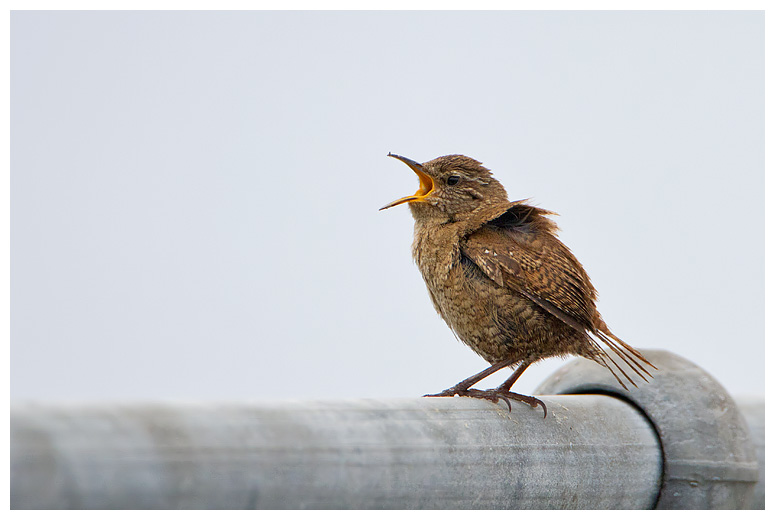
Tuesday morning started rather grey, but only in the weather sense, as by breakfast I'd already seen an otter fishing in a nearby bay, albeit at distance. With nothing planned for the day, I strolled down to the quayside, to see what I could photograph. Before I'd even reached the water, I could hear a wren belting out a song, and soon spotted the tuneful character, perched on the railings. He flew off when I approached, but after a short while, returned, to carry on where he'd left off. Also sat on the railings, unimpressed with the weather were the resident common terns, who weren't bothered in the slightest about me, and granted some exceptionally close views.
 When we'd first met Paula, she'd told us that we'd definitely see golden plovers on the moors behind their cottage, but the first trip up there, admittedly lacking in Timmy's presence (he puts them all up!), we'd failed to see any. So, with a few hours to kill, Ian and I headed up there. Paula was right, they were definitely there, but could I get close?Out the car and on to the moors, keeping low and moving slowly, I tried to approach one stood watching me from the top of a mound. It moved, I stopped... then it moved towards me, so I stayed still. Calling out constantly to another nearby, the golden plover cautiously trotted across the gorse to me!
 Not quite in full summer colours, but still with beautiful marked feathers, it was real treat, and returning back the cottage, the pics made a certain Kate rather envious. With them literally on our doorstep, meant we'd have another chance later...Back down to the quay again, and the wren was still there amazingly. This time though, perching on more interesting objects, so making much better photographs. And the light had improved too.
 Not wanting to rest on our laurels, Paula encouraged us out and about, and we soon found ourselves spread along a loch, looking for otters once more. As usual, Hawk-Eye himself (Ian) spotted one, and moments later, Kate and I were scuttling towards it, for a better view. I think she chose the more comfortable spot, nestled in the long grass above the lochside, whereas I found myself straddled a rusty old drainage pipe, beside the water!
 The otter kept to the other side of the loch, but was in and out of the water, sliding under the seaweed, climbing over rocks and of course, crunching away on its catch. They're ace creatures to watch - amusing. They're also ones for blending into the surroundings, and keeping a track of it was tricky. After a good 15 mins of viewing, it headed down the loch, up on to the shore and behind some large boulders, presumably into its holt. Yet another magical Shetland experience.By evening, the sun started to threaten to come out, and keen to quell her thirst for golden plover shots, Kate headed up to the moors again, with Ian and I in tow. Finding the plovers was easy - they'd not moved from where I'd seen them earlier, but getting decent light proved trickier. For a moment or two when we first found them, it was bright, and we got some great shots.
 But we had to wait a good hour before the sunlight really broke through, to get some vibrance in the images.
 The evening light was golden, appropriate really, for the birds being photographed, and the moors and lochs behind really added to the shots.
 What could have been a "quiet" day on Shetland, ended as usual, anything but, with yet another otter sighting at dusk. I got some shots, but they're a bit dark for processing, especially given results later in the week...