With the final full day in the Highlands pre-booked to be spent with Neil McIntyre, we chose to again head to Loch Garten for another go for the crested tits on the Wednesday, and unlike the previous visits, the sun decided to put in a most welcome appearance. Amusingly, this was the only day that Kate's handwarmer chose to warm up, on a day when it wasn't actually needed.
As before, the usual visitors to our feeders were coal tits and chaffinches, with crested tits coming in very occasionally. Kate had set up her Bushnell camera trap too, in the hope of getting some video captures of the cresties when they came in.
When the crested tits did arrive, we took as many shots as them as possible, including some when they approached, appearing somewhat like pixies in the trees.
Then they'd grab a beakful of food and vanish off into the woodland once more.
They seemed to be getting food from the trees anyway - perhaps small grubs hiding amongst the foliage, so weren't as keen on the food we had laid out as the other birds. By now we all knew the calls they make, so could pick them out from the other calls, and spot them as they flew around nearby.
With the light being so lovely, I had a mind to head to Lochindorb again, but Ann lives near moorland and has plenty of grouse shots from there, and with both Kate and I having had such good views earlier in the week, I chose to drag them away to have a look along the river Findhorn, in "Raptor Valley". Not only is this an area famed for seeing birds of prey (I've seen ospreys, golden eagles and a long-eared owl down here at various times of the year), but it is also simply staggeringly beautiful, with huge hills, snowcapped mountains and a cascading river flowing through.
But not before taking in the views around Loch Garten itself, which turned into a mirror on such a calm day. Beautiful.
Hoping to see golden eagles, I drove straight down to the end car park, though stopping along the way to check streams for dippers.
None around, though Kate thought she saw one flying low along the river. Ravens chased a sparrowhawk overhead, but no eagles alas. With showers starting to roll in down the valley, we were treated to a fine rainbow, well worth capturing.
Having learned how to spot mountain hares from Andy, we scanned the hillsides and, because the snow had melted from the lower slopes, spotted a couple of white hares crouched near rocks a short way up. Ann didn't need to be asked twice and followed Kate and me up the slopes towards the hares.
And using techniques from the day out earlier that week, we managed to approach them, close enough to get some reasonable images, which were welcome despite the 100s taken before, as these were without snow. Ann was chuffed to bits to have bagged some mountain hare shots, and scuttled off down the hill back to the shelter of the car, leaving Kate and me to traverse the slope to get shots of another individual nearby.
Heading back along the single track road, Kate managed to spot some hares down beside the road, though these were brown and seemed to have slightly longer ears than those higher up. They certainly weren't brown hares though and I couldn't get a shot in time as it legged it away before I could get at my gear from the back seat.
I also missed out on the goats that were feeding near the road, though Kate questioned why she was taking their pics, when she owns a pair of goats that seem to be remarkably similar in looks!
Neil had asked us to meet him near the Visitor Centre at Rothiemurchus and we were surprised to see a huge yellow Sea King helicopter descend over us, and land across the road. Certainly blew away any lingering cobwebs that morning.
Off to Neil's red squirrel location where I thought we would be in for the usual treat of seeing these cute characters, feeding right in front of us. Not to be though - one came down eventually, but only for a short while, as it appeared that they had perhaps been able to source food from one of his neighbours.
Being the gent that he is, Neil offered to let us try again on our last morning before taking us over to his crested tit photography site. Unlike the squirrels, these were on the scene instantly, and continued to perform for us all afternoon.
Last year I had battled with snow, sleet, rain and winds, struggling to get images as the light was so poor. This time we had too much light in some cases, with the sunlight making it tricky to get the exposure right and not blow the whites.
Still, with the brighter conditions, I could see the colours of the birds this time, along with the brightly coloured eyes. Such fabulous characters, and here, they seemed to rule the roost, bossing the other tits away.
As before, Neil moved the feeders around, allowing us to get shots of the birds on all manner of perches, advising us where he expected them to appear, and in most cases was spot on.
By the time the sun dropped behind the trees and the light started to fade, we had all got the sort of crested tit shots we had hoped for, and then some. And had a good laugh along the way with quite a bit of banter between us all.
Finally, to wrap up a fine day, and as it was Ann's Birthday, we walked (yes, walked!) down the road to the local hotel bar, and enjoyed some fine dining, great conversation and I got to down a few pints of Trade Winds again, without having to limit myself for a change.
And so the break had come to an end - we all got up early; Ann because she wanted to head back quickly and us so we could try for a couple of hours at Neil's place again.
While we saw one red squirrel at our second attempt, as before it didn't really stay for long, and with heavy hearts, we drove south, trying to absorb as much of the wonderful scenery and atmosphere as we possibly could. I am always gutted to leave such places, especially when the wildlife, scenery and company have been so fabulous, but I had to return Kate to her family, and make a start on processing some of the thousands of images taken during the week.
Once again the Scottish Highlands had delivered the goods, and for a change, I'd had the chance to share it with some great friends.
After the brightness of Sunday, Monday was disappointingly gloomy, but we'd have been optimistic to hope for much better weather after recent weeks, especially during winter. Andy had commented as we left him on Saturday that we might have some luck with crested tits at the RSPB Loch Garten centre, so with no plans for the day, we headed into the woodland to find several other folks had already set things up there.
With such clean air, getting attractive perches for our feeding stations was very easy - most of the fallen branches are clad in lichen and moss, so it was more a case of working out how to support the perch itself. Once that was done, we sprinkled seed and other food around, and stepped back.
Chaffinches and coal tits make up the majority of visitors, so I used them to get the settings right on the camera. As it was so dull I'd removed the TC from the 500mm, which allowed more light in, and as the birds were so close, it wasn't needed.
After seeing them at Allan's place, we were chuffed to see some more crested tits at this spot and at last, Kate managed to bag herself some shots of one. As did I - ignoring red grouse in poor light is one thing, cresties are an entirely different matter!
We were pretty pleased with how frequently they came to the feeders that day, though isn't that typical of birds when the light is bad? Same in my garden at home - if it's sunny, they go into hiding...
Still, we grabbed as many shots of them as possible before heading back to the cottage to meet up with Ann, who had travelled up that day. Once she'd settled in, I drove both her and Kate down into Aviemore for a most welcome dinner at one of the restaurants, and enjoyed a very nice pint of Cairngorms Brewery Trade Winds with mine. Mmmm...
Having enjoyed some success with the cresties, Ann was keen to join in the fun and get some shots of her own, so it was back to Loch Garten in the morning, again setting up a feeding station of our own, and again hoping for some visitors.
Not visiting our feeders, but close enough for pics was a treecreeper. As is the norm for Kate, she was rather excited to see one so close up as we followed it around the tree trunks, watching it probe and poke amongst the nooks and crannies. Great little birds.
With the light being as poor as the day before, and rain coming down, I thought it'd be wise to take shots of anything around, including the chaffinches, which to be fair, look rather vibrant inspite of the gloom. And if I'm being honest, I could do with some shots of them for my gallery anyway!
Much like Kate, Ann's reaction to seeing a crested tit was a mixture of excitement, joy and panic, as she tried to grab shots of it. They really don't hang around, and that morning tended to only come in occasionally, grab some food and vanish into the darkness of the woodland again.
The rain steadily got worse, and I suggested that we head up to see if the coast was brighter. This time, instead of going straight to Burghead, I tried Findhorn, as I'd read that it could be quite good for birds on the estuary. It wasn't warm when we got there, with a cold breeze and rain in the air, and a lone figure stood on a jetty, scanning what appeared to be a rather empty area of water with his scope was enough persuasion for us to head to the shelter of Burghead again.
This time, without the glare of the sun on the water, it was certainly easier to get the exposure right for the eiders, diver and long-tailed ducks, though I prefer to see the colours from the reflections.
The great northern diver came very close by, and I grabbed several full-frame shots as it drifted gracefully by.
As usual (and I received a great deal of ribbing from various folks) I stayed in the comfort of my car to take my shots. Both Ann and Kate braved the biting wind to get some of their shots before the weather chased them back to the car. Seemingly unbothered by the weather was Neil McIntyre, who recognised my car from last year and strolled over for a chat. We were to meet later that week anyway, but it's always a pleasure to meet him.
Three grey seals were fishing in the harbour, and two of them seemed to be very playful with each other.
They were also skilled at catching flat-fish, though eating them without attracting the attention of the gulls was more of a problem.
Amusingly though, when a great black-backed gull managed to steal one seal's catch, it was caught by a surprise raid by a juvenile, which snatched the remains of the fish and wolfed it down before it could be caught up with.
Sadly the rains caught up with us, and we chose to head back inland, to the warmth of the cottage. Another fabulous wildlife-filled day out and a fine introduction to some of the delights of the region to Ann.
Whilst walking back down the slopes from the hares to the car, we had noticed that a thaw had set in and the following morning we awoke to a lovely sunrise. Kate had arranged for us to meet Allan Bantick (Chairman of the Scottish Wildlife Trust) mid-morning, but we had enough time to zip up to Lochindorb for the red grouse, only this time I made the effort to get my camera out. In fact I went beyond that, suggesting Kate sit in the back of the car, so we'd both be on the best side of it, should we spot something.
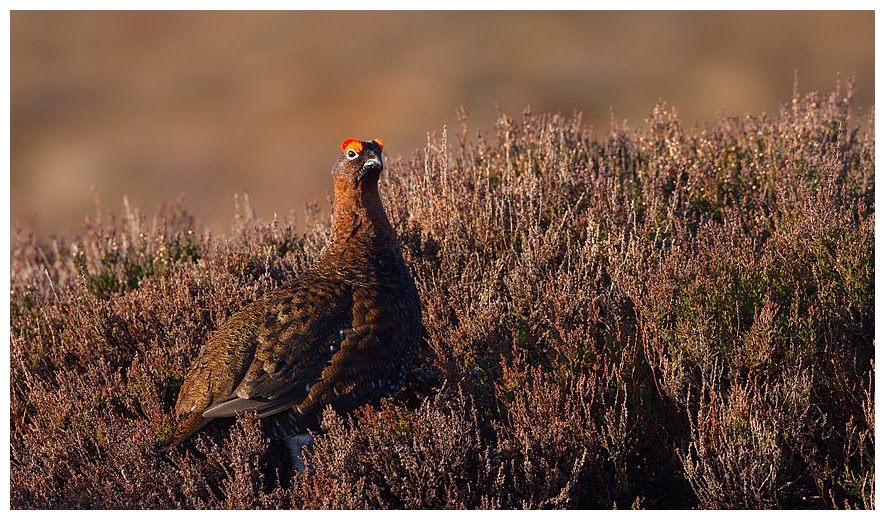
That didn't take long, as first thing in the morning the grouse seem to like to stand tall amongst the heather and call out, especially when females venture nearby. With the place to ourselves, I could park anywhere along the road, and line up the shots.
The morning light made the birds look fabulous, and really caught the males' wattles (their red eyebrows), especially when they raised them up.
Time flies though, and we soon had to drag ourselves away, though the prospect of seeing some crested tits at Allan's place had appeal, especially for Kate who was yet to see one.
Allan's house is on the outskirts of Boat Of Garten, and beside the woodland surrounding it. Hence he attracts both cresties and red squirrels to his feeders. Allan and his lovely wife Heather gave us a very warm welcome, as did their dogs, who as usual befriended Kate immediately. With coffee and home-made biscuits on the go, Allan started to tell us both about his work and what he is doing in the local woodland to assist the crested tit population, with his bespoke nest boxes. As the woodland isn't really suitable for providing nest sites, he has been putting up boxes filled with wood chippings, which the tits excuvate as they would with old decaying wood, from a dead or broken tree.
He has had varying success, but is still learning about their behaviour along the way, and, judging by the feeders outside of his house, they're happy to live in the woods. Kate was sat down, but I remained standing to watch through the window, and within a few minutes I spotted one arrive, and seconds later, Kate was gleefully watching her first crestie!
After a short stroll through the local woods, listening to Allan explain his work there and Kate offer some of her seemingly limitless new ideas, we thanked him for his time and hospitality, and set the sat-nav for Burghead. With the fine weather I wanted to see if the harbour had retained its appeal for the various sea ducks I'd seen there last year.
It didn't disappoint. On arrival we could see a few long-tailed ducks plus a pair of red-breasted mergansers, and after only a short while, they were joined by eiders, impersonating Frankie Howerd, as usual!
Talking to one of the locals, we also heard that a great northern diver had been seen lately and sure enough, it appeared in the mouth of the harbour.
Kate wasn't impressed by it, and I can sort of see why. In winter plumage they're a bit dull I suppose, but I just love the way they glide around, bossing the show, though even it had to be wary of the great black-backed gulls.
With the water sparkling in the sunshine and catching reflections of the colourful boats and buildings around the harbour, I again grabbed as many shots of the ducks, diver and mergansers as I could.
I mentioned to Kate whilst we watched, that I'd wanted to get some shots of the eiders feeding, if possible. Especially as they eat such unappetising creatures. Seconds later, a female eider surfaced with a crab and rather skillfully, juggled it in her beak to break off its legs, before crunching and then swallowing the body of the crab almost whole.
And much to my delight, a male eider then repeated the trick, right in front of us.
I guess living in the harbour isn't a great idea for crabs!
The light eventually started to fade and we headed back, with Kate jumping out along the way, as she has on the drive up there, to capture some of the magnificent scenery. Back to the cottage for a home-cooked meal, a long review of the masses of shots taken and to discuss ideas of what to do next.
I decided quite late this time to spend a week in the Highlands of Scotland again, so finding a cottage available, especially during English half-term break ought to have been more difficult, but Kate managed to discover a gem in Boat Of Garten, which had suddenly become free after a cancellation, and we were sorted. Readers of this blog should know that I normally go alone at this time of year as not many folks want to spend a week in colder weather than at home, but after Kate's comments since my last trip, I had miraculously persuaded her to take a break from her many tasks at home and for work, and see the delights of some of Scotland for herself.
As with last year's trip, my targets were ptarmigan and mountain hares, but with Kate in tow, I also arranged a day with Neil McIntyre for the red squirrels and crested tits. If I'm being honest, I'd have done that anyway! With the cottage being a Friday-Friday booking, it meant more of a challenge to work out the best time to head up there, avoiding rush hour and a band of yet more vile weather rolling in, and even more of a challenge of how to fit Kate's luggage into the car. Hannibal's elephants would have run a mile had they seen what she'd decided to take.
I needn't have worried as the drive up was painless and we were within the Cairngorms National Park earlier than expected. Not wanting to waste a moment, I suggested to Kate that she dig out her camera, and headed up to Lochindorb for a mooch. While the light wasn't brilliant, we soon got to see a few red grouse which as usual were remarkably close to the car. They were obviously much closer than Kate expected, as I tried to point one out to her, and she was looking past it, saying "Where?" until she realised it was quite literally next to her window, maybe 6 feet away, posing!
I didn't bother getting my camera out, preferring to soak up the atmosphere and ensure Kate got some decent first photos of the grouse. As the sun dropped behind the hills, we headed back to the cottage to settle in. We had a full day planned for Saturday.
After seeing the snow falling late at night, we were rather pleased to have timed our trip out with Andy Howard (www.andyhoward.co.uk) that day. Andy is a good friend of mine and made sure he found time for us, and after seeing the weather, advised that while ptarmigans may be possible, hares would be far easier. After dipping on the ptarmigan last year, I was happy to chase something else and the hares would look great against the snow.
One advantage of the snow being on the ground was that despite the skies being rather gloomy first thing, there was enough light to photo anything else around that morning. I had decided to ditch the 1.4TC from the 500mm, as it then allows more light in and yields slightly sharper images. Besides, if the images on Andy's site were anything to go by, we'd not be shooting from distance.
Footprints in the snow told us that hares (and other animals) were around, and we soon spotted both red deer and mountain goats in the area. The deer were way off, but worth a couple of shots to capture the atmosphere.
While Kate and I were picking our way through the snow-covered ground, Andy was busy scanning the area for hares and amazed me with his ability to spot them. Even when he'd taken a shot of the area one was sat in, it took me several seconds to see the hare amongst the snow and rocks. I guess it's a skill you'd get after the time he's spent with these wonderful animals, much like I've learned with spotting otters on lochs etc.
One of the many benefits of Andy's guidance, is that he knows where the most tolerant hares will be. From experience he knows that these will sit and, while keeping one eye on you, pretty much ignore you, which is great for getting shots. We soon found one such "sitter" and listening carefully to Andy's instructions, crept ever closer up to a point where you'd not want to be any closer for photos!
They're such characters - I can't decide if they look content, sat amongst the snow and rocks, obviously warm from their thick coats, or a bit peeved at their hard life in the hills. I can't say the idea of eating my own pellets to gain additional nutrition is appealing, but we watched them licking their lips after doing so.
Andy explained the behaviour of the hares, even anticipating what they were about to do, which helped for trying for some different images of an animal that is often simply sat still for hours!
While we focused on the hare, Andy kept a watchful eye for other action nearby, pointing out a small group of goats feeding and also a distant golden eagle soaring overhead. What a fantastic place for photography.
Proving nothing is ever constant with wildlife, Andy discovered that one of his favourite hares had been displaced with his usual form by another male. This one also allowed us close, though he did take a brief scamper around the area when another hare rushed by us. We took advantage of him being out of the form, of course.
As I started to get my eye in, I found that picking up the hares against the snowy backdrop was easier, mainly because I knew where to look for them after listening to Andy explain where they preferred to hide.
Of course any that were moving around were very easy to spot, though not to photograph - they go like the clappers! Fabulous to watch as they glide effortlessly over all the bumps and ditches we'd struggled over, at speeds that almost defied belief.
Before heading back to the car, Andy located the displaced male hare, mainly to check that it was ok. The concern he had for its welbeing was obvious - he truly adores these animals. And it's easy to see why. They each have their own character, behaviour and being so close to them during the day was a treat, not to be forgotten.
We thanked Andy for his time and tried to convey how much we had enjoyed the experience. If you ever wish to see these fantastic animals in their wild and unforgiving environment, you could not hope for a better guide than Andy.
A brilliant day out and a cracking start to the trip.
Since finally bagging the glossy ibis, I have been scratching around for places to go. The unusual weather patterns seem to have prevented a number of usual suspects from spending their winter in the UK, so I have been unable to get my fix of waxwings and short-eared owls, for example. I think suffering from the latter is called Withdraw-owl Symptoms. Ok, I'll get my coat.
I have been tempted to head back to the Wyre Forest for the crossbills, but along with the rain has been almost constant strong winds, and that makes seeing and photographing such birds nigh on impossible.
And the shrike is still very much a hit and miss affair. My good friend Max has tried several times to photograph it, resorting to a super-zoom bridge camera in a vain attempt to get a better shot at such distance, which isn't a bad option when the bird is perched. I used to have a Canon S2IS, which had incredible zoom capabilities for stationary objects, though the end result never got close to that from a proper D-SLR, which isn't surprising given the price difference.
But while the shrike stayed distant, I did catch sight of a sparrowhawk on a hunting mission, and despite being gloomy (a storm was rolling in), the camera (my 7D) managed to lock on as it hurtled by, and I ended up with a couple of pleasing shots, much to Max's disgust, as he'd missed it approaching!
Up in Coleshill, well, at Hams Hall, there is a Hume's leaf warbler, a rarity found by Dave Hutton, but despite 2 visits, I have failed to get a single shot of it. It seems to poke about in amongst brambles and only breaks cover to fly to the next set of bushes. Dave's spent over 20 hours there and only managed a couple of record shots. Hopefully his luck will change, though I definitely haven't the patience for that!
After hearing of Max's gymnastics at Marsh Lane (he attempted a backward roll whilst holding his camera, trying to photo the resident male kestrel) I thought I'd try there, and sure enough, spotted the kestrel hovering over the meadow near the car park. I soon worked out that he was returning to the same perch on a nearby tree after each hunting attempt, so I crept closer and waited.
Needless to say, he then caught a vole and headed over to the fence posts near the car park to eat it. I managed to get back to a reasonable distance, grabbing some shots, before the local corvids mobbed him, forcing him away down the concrete road to eat in peace.
Whilst waiting for him to return, I called into the Oak Hide and watched the lapwings and gulls scaring each other into the air every few moments; maybe just to keep warm. Was rather chilly when the sun went in.
When the kestrel returned, I again set up hoping he'd land on his favourite perch. He didn't, of course, choosing a new favourite just out of sight. However, with the light occasionally being decent, I grabbed a few shots as he hovered.
Then this last weekend, the forecast changed from the usual rain to offering a few hours brightness on Saturday morning. With the red-flanked bluetail on offer in Gloucestershire, I opted to avoid the crowds and hope my luck would change chasing hawfinches in the Forest of Dean. Thankfully despite the woodland being soaked, most of it is high up, so is clear of the terrible floods affecting many parts of the county currently. That said, many of the streams seem to be on the verge of spilling over and the lakes all looked very muddy and churned up.
So, did my luck change this year? Yes. I managed to connect with 4 hawfinches in the end, and come away with some half decent shots, even though they tended to hide amongst the branches mainly, and were always the last to feed from the ground, and of course, first to fly off.
They were hanging around with a flock of chaffinches and greenfinches, the latter showing acrobatic skills to feed on the fruits of the yew tree. The hawfinches simply broke off small branches and then helped themselves to what they wanted.
As they were so tricky to focus on, I had to use the spot focus point on the camera, and was glad of the rear-focusing button set-up I use, as I could focus, and release, and then take shots with the shutter-release, not worrying that the camera would refocus on one of the branches moving around in front of the bird.
Eventually it started to rain, and after predicting it would stop after a few mins, I gave up when it became torrential 30 mins later! Worth the drive out though - such fabulous birds.