It's funny how involved with events, even tiny ones in nature that we can become. I see this quite frequently with Kate (WildlifeKate to her crowds of fans) when she experiences the highs and lows of parts of the lives of animals she encourages on to her land. Perhaps because I'm darting around between different subjects, I rarely see the whole story of something, so don't become attached; maybe I'm missing out?
A couple of years ago I decided to make more of an effort with attracting wildlife to my garden and dug out a pond. I have avoided the urge to bring in species to it, like from another pond for example, leaving nature to do its thing. And it amazed me how quickly it arrived, with newts populating it in only a few weeks.
Back in 2012 I noticed a large dragonfly (southern hawker I believe) buzzing around the garden, and was very pleased to see it drop down to the pond, and start laying eggs around the edges of it. I even had chance to grab some shots as it did so.
Since then I have seen the nymphs frequently, sometimes even catching them when I'm trying to remove the slime from the water. I still haven't worked out how to judge those parcels of barley properly. Fascinating creatures, how they stalk around the depths of the pool, shooting forwards to grab things and consume them. And so large too - even the newts keep a distance from these wee beasties.
So if they were laid as eggs in August 2012 and the articles I have read claim they emerge after 2-3 years, surely I might see them this year? This is what I hoped, and when possible, I have been checking the pond each morning. Annoyingly, last week I discovered a discarded exuvia, floating on the surface. I had missed one emerge! Hopefully more were still to come...
On Saturday morning, at 6am I was awoken by the rumbles of thunder of the much forecast storms, and the rest of the morning was restricted to being indoors as the torrential downpours continued, and when it did brighten up, I chose to head to Upton Warren for the afternoon. And in doing so reminded myself that RAF Cosford's airshow was on the next day... However, just as I was about to leave on Sunday morning, something nagged at me - check the pond.
It's not a big pond so it didn't take long to spot them. One dragonfly had already broken free and was perched, wings open drying off, and another nearby was midway through the process of emerging from the exuvia. A dash back inside to rig up the 7D and 100mm macro, and I was soon crouched beside the pair, trying to get shots through the moving reeds.
The one drying off must have had a very early start, as by the time I started to observe, it was already perched up away from its discarded exuvia, wings open at 90 degrees, and starting to vibrate them too.
The other was halfway out, using gravity to help it ease out.
Crouching for any length of time soon becomes painful, so I popped indoors to grab a bin liner, to sit on. In the time it took me to get that and return, the emerging dragonfly had pulled itself out, and was now gripped on to the exuvia, with various vessels still attached, presumably transferring fluids.
The wings appeared somewhat like a deflated balloon, hanging from its back.
With each passing moment though, they got longer.
And longer...
And longer, until they actually resembled proper wings, although these were opaque still.
The other dragonfly was now out in the open, frequently vibrating or even fluttering its wings. I took a few shots of it, guessing it'd be off shortly.
I was right, and it took off on its maiden flight, off over my apple tree and into next-door's garden. Great to see it head off into the great wide open.
That left the other, which was hanging from the exuvia, drying its wings.
A lengthy process, and unfortunately this is where the story takes rather a downward turn. I had been getting annoyed by the breeze moving the reeds around in front of my lens, but what I didn't see (until I reviewed these pics) was that the dragonfly, when in exuvia form, hadn't made a very good job of affixing itself to the reed.
With one slightly stronger gust of wind, the exuvia broke free of the reed and it, with its newly emerged dragonfly tumbled down to the pond below, getting snagged just above the water, on some other reeds. Wriggling free, the dragonfly broke off the exuvia, and then climbed up the reed itself, but had twisted and folded its wings in the process.
When I took some more pics, after it had settled to a new hanging position, I could see droplets of green fluid on its body and wings, possibly from when it broke off the vessels, but also perhaps from damage to the wings themselves? I was worried that this could be the end of it - if the wings were damaged, it couldn't then fly. Surely evolution of this species has had to cater for windy days before?
Unfortunately for me, work (yes, on a Sunday!) then got in the way, and I had to leave the drama, to hopefully unfold (literally) by itself. Returning later that evening, I found the dragonfly still in the same place, with clearer wings and hence giving me some hope that it might survive.
It had gone by the morning, so I live in hope that it flew away, like the other one, but it could have of course been predated by one of the many new additions to the bird community in my garden. Since the weekend, two more dragonflies have emerged, and I think I'll need to be up earlier to see any more!
I tend to travel the length and breadth of the UK to see some fabulous wildlife spectacles, but it just shows, you can see some fascinating stuff, that captures your imagination and emotions, just in the confines of a small garden pond.
It's strange how you can go through some years and completely miss out on seeing some favourite species of birds. Last year for example, I failed to connect with any puffins or ospreys. Which reminds me, I need to head up to Rutland. Puffins however, would surely be seen if I went up to Bempton Cliffs, so an early alarm was set (not too early as some of the motorways heading up there are closed during the night!), and just before 9am, I was kicking up a cloud of dust as I parked near the RSPB visitor centre.
I ought to point out now that I hadn't made the 3 hour drive up there for puffins, as despite them being there, photo opportunites aren't great. I was really hoping to see gannets, fulmars, kittiwakes and any other cliff-nesting sea birds I could encounter. Despite the sun shining and a promise of a warm day, I still chose to wear a fleece just in case it was breezy along the cliff-tops. And I was glad I did, though not for the breeze... no, for protection from the flies. Clouds of them in their millions, and biting ones too. I doused my head with some spray, donned a hat and swiped off any that bothered me, but some folks was covered in them. Horrid. When the breeze picked up occasionally, they peppered my hat as if they were rain drops.
As usual the first thing you notice at Bempton is the odour of fish drifting up from the nesting area, but more pleasingly, I also got a lovely song from a nearby corn bunting. It was sat on a barbed wire fence belting out songs, with its beak moving so fast it became a blur, even on a high shutter speed.
Peering over one of the view points I was chuffed to see a kittiwake looking back up at me. White birds in direct sunlight isn't easy, but being observant of the exposure readings in the viewfinder allowed me to get some decent detail on the bird, before I strolled off.
The cliffs were a mass of activity, both on the rocks where all manner of birds were nesting, bickering, greeting each other, stealing nest materials, feeding and decorating the rocks, as well as in the air where gannets and fulmars sailed expertly along with minimal effort, contrasting to the frenetic direct flight paths made by the puffins, guillemots and razorbills.
On the water were rafts of birds, maybe enjoying the view from down there, waiting to see if anything worth catching swam by beneath. It was a fabulous spectacle on such a sunny, clear morning.
Being a such people-person, I soon found myself away from the crowds and pretty much alone on the cliff path, surrounded by a sea of campion flowers. I found spots along the walk where I could view the colonies, and in some cases, get remarkably close views of the birds.
I could also get angles where the background was more pleasing on the eye, as a lot of shots taken here have cliffs behind, usually a mass of other birds and droppings. So not that attractive.
The flies were still a problem and I have had to clone some out of some images, as they were rather unsightly. By crouching down, I attempted to include the wildflowers in some shots, though more often than not, the subject would move before I'd lined up the shot I was striving for!
After finding somewhere to set up where I could watch the birds fly past, I simply enjoyed the experience. I tried for whatever was flying past, which was fun. The gannets were usually easier as they are large enough to focus on at distance and track as they approach.
Fulmars too drifted by but have a habit of turning back without warning and heading out of view.
And I kept an eye out for subjects nearby, particularly gannets which were coming and going frequently, and showing signs of affection to one another when together on the nest sites.
Wearing a hat and fleece in temperatures of over 20C isn't wise, and my bottle of Ribena was getting emptier. So I headed back along the cliffs, grabbing shots of whatever took my fancy, though the haze from the warmth was now pretty apparent. The local tree sparrows were making the most of the bonanza of flies though, carrying dozens in their beaks as they hopped along the fences, picking them off easily.
By the time I had reached the car again, my feet were aching and I'd maybe lost a few ounces from sweating! Not a pleasant thought, though neither was the return trip down the M1 motorway. Still, I'd had a great few hours at the reserve, and had hundreds of images to review later.
And did I see a puffin? Of course, and even took a "record" shot to remember it.
As is becoming the norm of late, I've been neglecting my blog. Quite often because I've been using spare time for other things, like work. But if I don't get it down I'll forget it, so here I am.
Farmoor
It made a change for me to head to Farmoor in Oxfordshire. I have often heard it mentioned by other wildlife enthusiasts, especially by locals at Otmoor, so when a red-necked grebe was reported, I took the opportunity to take a look. Unusually for me, I didn't spend a great deal of time planning and researching the site, preferring to drive down and work it out for myself on site.
Mistake.
Foolishly I assumed that the 2 reservoirs would be labelled in terms of size, with F1 being the largest, and F2 where the grebe was favouring, the smaller. Hence I strode purposefully across the causeway to where I had confidently worked out where the grebe would be. A returning birder then pointed out, as I asked where the grebe was, that the larger pool was F2, and hence I was miles from where I needed to be. D'oh!
Hot-footing it to where the grebe was, I bumped into some more togs, who had set up on the actual concrete basin of the reservoir, so as to get low-level shots. After a short period of waiting for the bird to wake up, it approached and with a few sprints to new locations when it was underwater, I managed to get a few decent images.
I have seen one before in such lovely plumage, over at Gailey reservoir. But this was much closer.
It was very good at catching fish, and after wolfing down a few, it headed back out for another snooze. Which became the pattern of the day, though the light wasn't really in the best direction, and with the boats coming out on to the water, it tended to move to the end of the reservoir nearer the causeway, which was convenient for me to wander back when finished.
Otmoor
I try to keep an eye on reports from Otmoor and when the hobbies arrive back, I head down to see them. Despite being fairly early on site, the car park was very busy, and I tried to head to areas with the fewest folk, though to be fair, Otmoor is a big place, so can still appear to be empty even with so many cars parked up.
As usual, I checked any sun-drenched logs or stumps for reptiles, but failed to see any, though a singing wren near the bridge made me stop and grab a few shots.
On the pools behind the main path, I could see a distant little egret poking around, striking at anything disturbed as it walked through. And the hedges were a mass of singing whitethroats and warblers. I could also hear cuckoos calling, though way off somewhere else!
Near the hide I could see lapwings swooping over something in the conservation area, so peered over the gate for a closer look. A brown hare. It moved to an area where it was more peaceful, and I tried to get some shots. Even at this time though, the heat haze was up and most images were soft. Then the hare started to approach where I was standing, so I remained stood dead still. Closer. Grabbing shots all the time. Would I get some decent images at last?
No. Because a birder approached, and despite me whispering to him that there was a hare nearby, he then recounted a tale of how one had walked up to him one day, with the sort of volume one would need to fill a theatre with sound, and surprisingly enough, the hare buggered off. I think a trip east might be needed for that photo opportunity, perhaps.
As is often the case at Otmoor, insects provide as many photo opportunities as the birds and mammals. I spotted lots of butterflies around and managed to get shots of orange-tips and others.
Hares aren't really the main concern for the lapwings though. Red kites are, and as with last year, they were (in greater numbers this year) hunting the meadows where the lapwing chicks were trying to grow up. Probably 19 times out of 20, the lapwings, gulls and corvids would succeed in chasing the red kites away, but the more determined raptors were diving right down, and flying off with unfortunate chicks.
Hobbies didn't seem to attract the attention of the lapwings, so were busy taking out any insects on the wing they could target. Mostly they were high up, but every so often they would descend together, and I'd try to get images. Again, the haze affected the focus, so most were binned.
I saw a couple of cuckoos flying around, but never perching in view. And a lesser whitethroat also teased, singing from a hedge but never appeared. A reed bunting sat atop of the same hedge, so I settled for shots of him instead.
The remainder of the day was spent photographing the rather swanky-looking male pochards from the end hide.
And on the way back to the car, aside from avoiding the clouds of flies, grabbing occasional shots of the red kites when they circled overhead.
I'm hoping for another bright day soon, to head back down for another go at everything.
The gales, rain and cold seem to have finally made way for what can I guess be described as less windy, less rainy and slightly warmer weather, at least here in the Midlands. I look forward to Spring each year as everything takes on a fresh look and with the leaves appearing on trees, I can enjoy more privacy in my garden as the hedges fill out and obscure the views of the houses behind.
Along with the greenery has come an abundance of flying insects, and any that enjoy a drop of blood seem to be feasting on me every time I venture out. I really am a Midge Magnet, though they also attract goldcrests, which are always a treat to see.
So with all the better weather, leaves, flowers, insects around, you'd perhaps be forgiven for thinking nature can now provide all the food needed for your garden birds, so no need to put anything out until winter returns... and that would be a mistake, judging by what I have seen of late.
If anything, the birds are consuming more food now than they did over the winter months, especially the house sparrows. I am fortunate to have a healthy population of these "little brown jobs" and they are constantly flying back and forth to the feeders.
The issue is, while everything looks fresh, green and full of life, in terms of actual naturally-available food for the birds, we are in something of a void or as some call it, the hungry gap.
And if you consider that as well as looking after themselves at the moment, a lot of our garden birds have hungry beaks to fill at their nests, the need for food is greater than ever.
From my observations, I can see that the general mixes of seed are most popular currently, perhaps because the number of sparrows around my feeders is such that other birds can't get a look in, though I have seen blue, great and coal tits darting in for a black sunflower seed or a heart. And the suet balls seem to have at least one sparrow attached to them at all times. They were also attracting blackcaps a couple of weeks back too, though never when I had a camera at hand. And of course robins battle their way to the feeders, preferring the seed trays to the hanging feeders generally.
There are of course numerous online articles covering this subject in far greater scientific detail than my musings, but one of the best I have seen is here at Vine House Farm on their blog. Might have to try some sultanas actually... for the birds, not for me. As a child I remember always being disappointed to discover that the dark blobs in a cup cake were actually sultanas and not chocolate chips!
I am also about to get some live meal worms, (definitely not for cakes) as despite spending my lunchbreaks poking around in the shrubs and bushes of my garden, I am yet to find any caterpillars out there, which are definitely a favourite of tits to feed to their nestlings.
I'm sure most readers of my blog are aware of the message about feeding birds all year round, but for any that aren't, please consider this time of year; winter is over, and while summer is round the corner, natural food is actually scarce for wildlife, and we really need to continue to feed the birds.
It is pretty apparent from this blog and the photos on my various web pages, that I enjoy photographing birds of prey. Buzzards, kestrels, peregrines, red kites, marsh harriers and some owls are fairly easy to see, whereas species such as the mighty white-tailed eagle can be photographed from specialist boat trips, for example. Some folk (not me) seem to see sparrowhawks frequently in their gardens, and if you spend enough time on isles such as Mull, you'll get to see glorious golden eagles and occasionally hen harriers too.
There are some birds of prey though, that are a lot more difficult to photograph. I managed to spot a merlin last year in Mull, but despite several visits to the Forest Of Dean, to viewing sites such as New Fancy View and Symonds Yat, I'd not yet connected with a goshawk. Most recently, on a trip to Symonds Yat, I was informed by the RSPB guide that a pair of goshawks were displaying. I was just starting to get excited when he pointed them out. On the horizon, which from a raised viewing spot, is a long, long way off.
Most years, by the time I've decided to target something, the time to view them has passed, and being rather absent-minded I forget to target them the following year, but this time, I managed to remember to focus on one bird, the goshawk, and to put in a substantial amount of time at some more local sites. The site in mind is in Shropshire, and I'm being deliberately vague with the location for obvious reasons.
After reminding myself what to listen out for, and taking the time to read up on the birds and their habits, I headed to a spot out in the woods, and set myself up. It made a change to be out on a day when it wasn't raining or blowing a gale, and I found myself distracted by flocks of finches in the area. Getting shots of those wasn't easy as mostly they were above me, and that tends to yield photos that are, well a bit naff.
It was whilst scanning for finches at a lower level when I saw it. Between the branches, a glimpse of something big, circling the tree tops. My heart stopped. Almost giving myself two black-eyes from swinging my bins up too quickly, I desperately tried to focus on the bird as it appeared and vanished through the foliage. The white eye-stripes and that red eye. Goshawk. The camera was of course set up for the right conditions, but try as I might, it failed to lock on and seconds later the goshawk had gone from sight. No pictures, which was annoying, but I'd seen one, and pretty close too. Fab.
Moments later, I had relocated to a spot where I could see more sky, and I clocked a bird high up, circling. Initially, as it was so far up, I wondered if it was a peregrine, but took a pot-shot to zoom right in on. Not a 'grine. Goshawk. It stayed very high though, and soon disappeared. It was safe to say that my attention had been grabbed.
It was about midday and the skies were clearing nicely. I had nothing else to do that day so didn't mind waiting for another view. And waiting. And waiting. Part of the problem is that once a goshawk appears, everything else with any sense (counts me out) goes into hiding, or flees for its life from the area, so there really isn't much to point the camera at in the long periods between sightings. But thankfully I got another view, as after hearing one call, it sailed over the tree tops and without foliage to block it, I could get the camera locked on. At last, a goshawk photo.
They're awesome birds; powerful, purposeful and the combination of those red or orange eyes and the white eyebrow-stripes gives them a killer look.
No prizes for guessing where I was the next day. Only this time, instead of seeing the adult birds, I generally saw a juvenile, or first winter (male I believe) which was being very vocal in the area I was stood.
Flying down between the trees in front of me, I only just got it in the frame - they really shift!
And then it appeared over the tree tops, circled and vanished from sight.
But not before giving me some great side views of its markings.
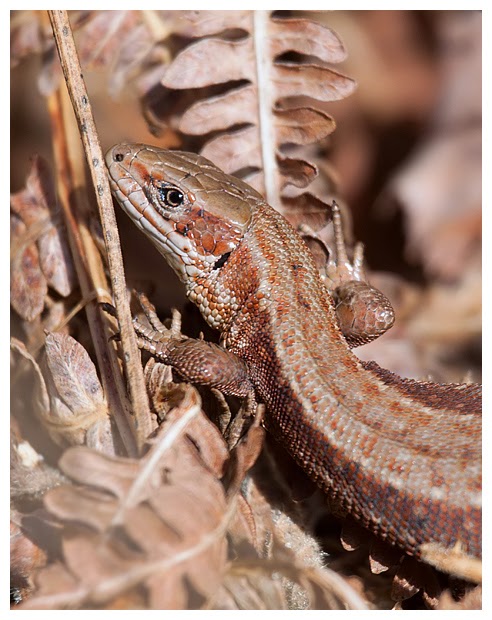
Since that first weekend, I have been back several times. I won't detail all the hours stood staring at the sky and not seeing anything as you'd be as bored as I was. Problem is, you can't look away for a moment. I did, when I spotted a lizard basking in the sunshine. I dug out my appropriate lens, approached and took some pics, and just as I wandered back to the usual spot, a blue tit went beserk, I spun round and the juvenile goshawk hurtled past, no more than 5 feet from the ground and off into the trees of the valley below me.
Still, good to see a common lizard, I suppose...
Another instance that sticks in memory was when I glimpsed a large bird perch up in the trees across the valley from me. I couldn't see it where it had landed, but I got to see it fly off, powerfully, low and so quickly between the tree trunks, disappearing from view within seconds, and setting off all manner of alarm calls from birds in its path.
As expected, the juvenile bird was soon pushed from the area, and I tended to only see the adults thereafter. I got a brief view of a pair displaying, albeit at distance too, accompanied by lots of calling by both birds.
On one visit, I spotted a bird circling above, and lost in the excitement of it all, fired off lots of shots believing it was a goshawk. Something about it wasn't quite right, and when it had gone, I checked. Sparrowhawk! Swine had tricked me. Still, not to be sniffed at in such lovely light.
Just an hour later though, the real deal flew in, and gave me terrific views as it circled nearby.
With the sunlight catching that red eye, he looked amazing, and I grabbed as many shots as I could.
Maybe he was enjoying the sunshine, but he just circled for a short while, then dropped into the canopy.
Moments later, the female appeared, also circling in the same area.
What a treat!
And in some rare sunshine too.
They both landed in some trees near me, but I couldn't get a view, and didn't want to risk moving in case they broke cover and I wasn't ready. They did, with the female skimming the tree tops as she headed off, and the male not far behind, but choosing to take a path through the woods, not over them.
I was left grinning like an insane person.
However, to put that experience into context, I have been several times since, and only glimpsed them, usually one miles up in the clouds, or stood and seen nothing at all. So I guess that makes those few moments even more magical.
I have only one word for goshawks: awesome!