After missing out because of the pandemic and all its restrictions in 2020, Andy and I were relieved to be able to run our summer photography tours here on Mull through July, though this time it would slightly different in that I wasn't staying in the accommodation with the clients. While this added about an hour to my day in terms of travel, it was so much better to be able sleep in my own bed, instead of whatever I was lumbered with in the digs. Usually some sort of inflatable mattress in a sleeping bag.
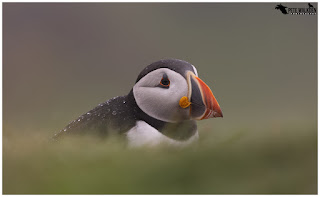
Almost all of our previous trips out to Staffa and Lunga had seen bright, dry weather, but the first one of our visits was wet. I was actually pleased, after seeing some wonderful images Lyndsey had captured during a very wet visit, with puffins sitting around covered in beads of rain. Maybe it was the wrong sort of rain, but the puffins didn't seem to like being wet, and kept shaking the rain off of them.
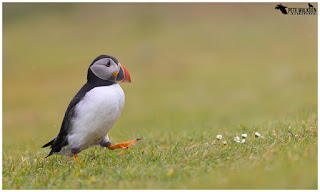
It was good to see some of them out collecting nesting materials though, and this allowed us to lie down to photograph them as they scuttled around on the grass.
Of course what most clients aim to get photos of, are flying birds, especially the puffins. What was noticeable was how much better at tracking the birds the latest mirrorless cameras are compared with even the top of the range professional D-SLRs, to the point that we'd try an idea of a shot with birds in flight, and the Canon R5 in my case, would nail the shot almost immediately, leaving me wanting to try something else.
The settings on these cameras is key though, and by adjusting clients' cameras to match my own improved their hit rates enormously. Of course I have years of experience with photographing birds in flight, even tricky ones like puffins, so that coupled with the incredible AF on the R5 meant that during moments of downtime, where the clients were immersed in their own quest for shots, I was able to dial down the shutter speed, and attempt to pan the puffins. No, not over a fire, but with a panning movement to follow them in flight, blurring the background and their wings, but keeping the head and feet in sharp focus.
Funnily enough, the hardest part was getting an image that actually showed movement in the background, rather than tracking the puffins.
Our second and third visits to the Treshnish Isles were back to normal, with bright and often sunny conditions. This creates shadows and lights up the feet of the puffins as they fly in.
What the sun also does is give rise to sparkles on the water, and that can create an interesting effect behind the birds as they fly in front of it. However, this mass of contrasting blobs confused the AF on the R5 and it repeatedly failed to lock on to the birds. I solved this by disabling the emulation mode on the electronic viewfinder, which shows the view as it would be through a D-SLR, and that allowed me to get a lock.
After the sparkles came more shadows and contrast, and I attempted to capture images of the birds as they flew against a shaded area whilst being lit up by the sun. Again it was challenging to obtain and maintain focus, but was fun, and I enjoyed some success with it.
And it was a treat for all to see a puffling looking out of its burrow occasionally, on our final trip to Lunga.
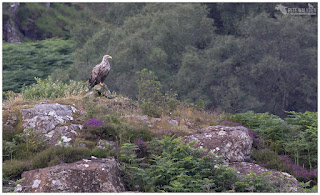
The private trips out with Mull Charters for the white-tailed eagles are always a highlight for me, even though I was running my own workshops using them, and working alongside Martin or Alex aboard the Lady Jayne throughout the summer.
The eagles were always on form, but we were also treated to some great views of cetaceans, with a minke whale getting my pulse going, being the first whale I'd ever seen. The less said about me missing out seeing orcas in Shetland one year, the better.
And of course back on Mull itself, we managed to find some otters for the clients, including one remarkable encounter where a young dog otter sauntered over to where I was lying on the shore beside the clients, and sniffed my boot!
And because I was using an R5 which is silent, and had my 100-400mm lens attached, which allows for close focusing, I managed to get some images when it was slightly further away from me, showing some incredible detail on the otter.
Once the tours ended, I had a bit of time for myself, and enjoyed some down-time with friends who had travelled over to Mull to catch up with me, and also to photograph some of the wildlife and views on offer.
We enjoyed some wonderful encounters with the eagles from the Lady Jayne, otters around Mull and towards the latter half of the month, spent a great deal of time pointing our cameras at the families of short-eared owls that had been raised over the summer.
It reminded me of some of the winter sites I've visited for the owls over the years, when there are so many flying around that you don't know where to look. It was wonderful, and we saw the owlets flying to meet their parents for food, and also the sound of them begging for it, from the vegetation. Once one started, they all joined in.
What was noticeable though at the end of August, was that some of the birds that had been a constant sound throughout the warmer months, had started to, or had actually gone. They'd left the island once more, and it began to get quieter.
Something I expected to be more apparent as summer made way into autumn and eventually winter, but that's for another post.
At the beginning of 2021, with plenty of time on my hands, and lots to see and do around Mull, the idea was to keep this blog updated every week or so. That was until the end of May, when the world opened up properly and a tsunami of work came my way in the form of workshops and crewing days out on the boat. And welcome it was too, after the drought of opportunities caused by the pandemic.
So over the next few posts, I'll try to cover off some of what I saw and photographed during each calendar month, here on Mull.
Late May
The end of May saw me spending a few days with Oliver Wright, a friend and also a genius with macro photography. He's spent many a week here on Mull before, but was keen to visit when he heard I'd moved here, and wanted to tie the trip in with a search for insect-eating plants, namely sundews. He was hoping to find insects trapped in the sticky goo on the plants, and be able to do a stacked image of one.
We headed down to a glen near Loch Buie and proceeded to walk about five miles in search of the plants. We found plenty along the way until eventually we spotted a small clump near a stream, and insects were trapped. Having learned how to do a macro stack during lockdown, I had a go too.
Amusingly, after hiking back to the car, we discovered a pool about fifty metres from where we'd parked, which had dozens of the sundew plants in, and they had caught insects too!
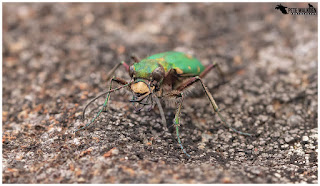
Also seen along the way was a striking and vibrantly coloured green tiger beetle, which never seemed to stay still. I managed to grab a couple of images as it scuttled around the ground, but amazingly, in one of the moments when the beetle stopped, Oliver managed to stack some images of it, and came away with a stunning shot.
June
As well as seeing Oliver up here on Mull, we welcomed first Andy for a few days whilst he was running a few workshops in June, and then shortly afterwards, Lyndsey spent a week here immersing herself in the wildlife. When possible I spent time with both, running workshops the rest of the time.
Rather than try to recount the numerous adventures enjoyed over the month, I'll post images and add some accompanying text. Most folk probably only look at the images anyway!
One of the sounds of the summer for me comes from the chatter of swallows. They're everywhere at times, even choosing to nest in the eves of the new metal shelter outside the local pub. But one old wooden building seems very popular, and I would often wait nearby to watch the antics of these acrobatic birds. A gap in the panelling gives a great look-out for them, and also makes a good frame for an image.
A bird that caught my attention on my very first visit to Mull over a decade ago was the cuckoo. It was May when we stayed, and we saw plenty of them, but I didn't get any really decent images. So this year, when their distinctive calls drifted through the glens, I was out taking images of them as much as possible. And with the amazing auto-focus of the Canon R5, I captured quite a few in flight too.
Another bird call that fills the air during the warmer months is that of the common sandpiper. They seemed to be on every shoreline during the summer, and once their young had hatched and were pottering around in the vegetation or around the stones on the shores, then the sounds became louder than ever. Mull is so quiet when they've left.
After seeing several when out on walks during the lockdown periods, it was great to spot another Irish hare on my way to collect clients one morning, and for it to still be out in the open as I headed out with them, enabling them to get shots of it too. They're usually out very early in the morning, or at dusk.
I'm hoping that 2021 wasn't a one off for breeding success of short-eared owls, as I can't recall ever seeing so many around Mull from late spring right through to August. Back in June though, when Lyndsey was here, we went out just for a mooch around the isle to see what might be about, and found a few of these, and it was amusing for someone like me, who almost obsesses about these owls, to see someone else fall for their charms.
There were signs of breeding success from resident birds like stonechats, and also from migrants, like their rarer cousins, whinchats.
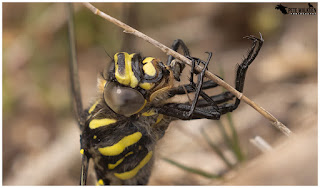
As well as birds flying around Mull, there were masses of insects too, including the striking golden-ringed dragonfly.
And basking under warm vegetation, or in this case, some corregated metal laid out, were slow worms. Adders were seen, but were always on the move.
With all the flying insects around, it wasn't a huge surprise to find birds that like feeding on them, and I saw a few warblers around, though flycatchers were generally easier to photograph. That said, this one was posing in a small coppice and the air was filled with swarms of midges. I grabbed some shots before I followed Lyndsey's actions, and fled back to the safety of the car.
With numbers elsewhere in the UK falling, it was good to see plenty of curlew around Mull, feeding on the shore and around the moors. They seemed to have quite a few chicks too.
Pipits were a common sight, with rock pipits around the shoreline, picking up insects from the drying seaweed, whilst on dryer land, meadow pipits were busy targeting insects attracted to the plentiful supply of manure from livestock.
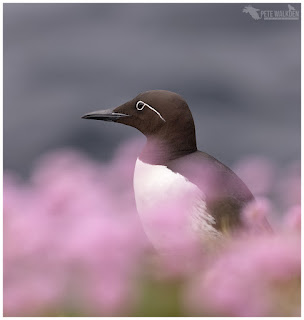
Late May through June saw me visiting the Treshnish Isles frequently, mainly for workshops. As usual, most of the time spent with clients focused on the puffins, especially as the island of Lunga was carpeted with bluebells for several weeks. As with previous years, there were plenty of other species around, and I thought this year the number of great skuas (bonxies) had increased, as they seemed to be terrorising the smaller seabirds constantly at times.
There were differing fortunes for the eagles on Mull. While the white-tailed eagles had a brilliant breeding season, to the point that one nest raised three chicks and two other nests were able to donate an eaglet each to the Isle Of Wight project. The golden eagles struggled, with several pairs failing to raise their chicks. One did though, and proved to be a popular spot for folks to watch on from the roadside. Almost all of my eagle images from May and June were of the white-tailed variety, and mostly from the Lady Jayne as workshops were very popular aboard her, and I also spent a fair amount of time helping out Mull Charters.
Hang on, you might be thinking, you've not posted any shots of otters! Most of my workshops are based around otters, so needless to say, there were quite a few encounters throughout these weeks with the various individuals and families living on Mull. I've selected a few from these days out.
Hopefully this covers off a fair bit of what I've seen and photographed over those weeks, and provides a taste of what might be encountered should you choose to visit Mull late May through June. July will be up next, and expect more otters, eagles and puffins, as it's the month that Andy and I run our summer tours.